
Explain That Election
This is a prototype website providing educational materials that are designed to: help people understand the role and structure of government in Australia; how we vote in our elections; and how those votes are counted.
Explain That Election allows users to select a past state or federal election, and a house of interest within the chosen state or federal parliament, and then step through the count for a chosen seat or region.
The purpose of this prototype is to guide us (Democracy Developers) in the design, development, and direction of the 'live' version for public consumption.
Australia is a representative democracy. We elect representatives to three levels of government, each with different responsibilities.
Federal Parliament
Our Federal Parliament consists of two houses.
The House of Representatives
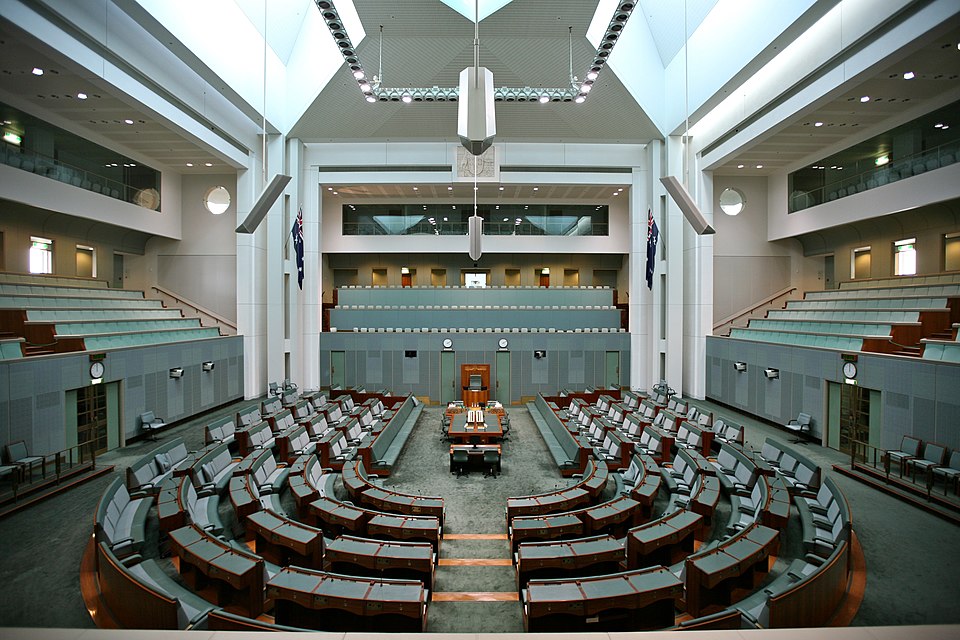
Wikimedia Commons, Alex Proimos, CC BY 2.0.
The House is a chamber with 150 seats. Each seat represents a geographical region in Australia called an electorate, and is held by a Member of Parliament (MP).
At each federal election, the voters of each electorate will elect a candidate to hold their seat, and represent them in the House. Each candidate may be part of a political party, or affiliated with no party (an independent).
The political party who wins the majority of seats in the House forms the federal government.
Each member of the House has a 3-year term. A federal election must be held at least once every 3 years so that the Australian public can elect a candidate to sit in their electorate's seat in the House.
The Senate
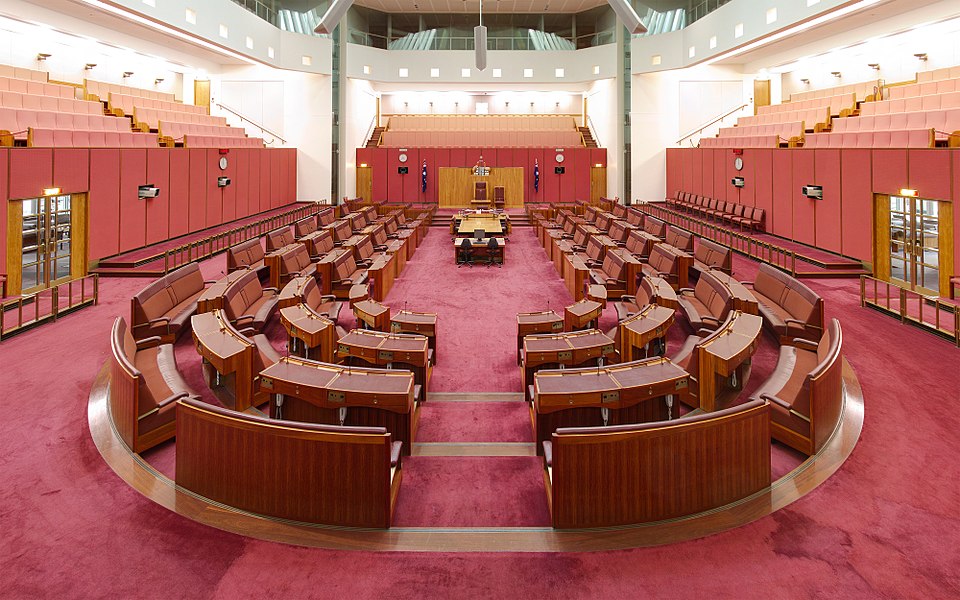
Wikimedia Commons, JJ Harrison, CC BY-SA 3.0.
The Senate is a chamber with 76 seats. Unlike the House, these seats are divided up between the states and territories.
Each state is represented by 12 senators, while each territory has two senators. Each senator has a 6-year term. At most federal elections, half of the Senate's 76 seats will be up for re-election. The other half will be up for re-election at the next federal election.
Each senator does not represent an individual electorate like members of the House. They represent their state or territory.
These two houses work together to make federal laws on matters that fall within their set of responsibilities. These laws apply Australia-wide.
Federal Responsibilities
The Australian Constitution outlines which areas fall within the law-making powers of the federal parliament. These include, but are not limited to, foreign policy, defence, taxation, citizenship, immigration, and international trade.
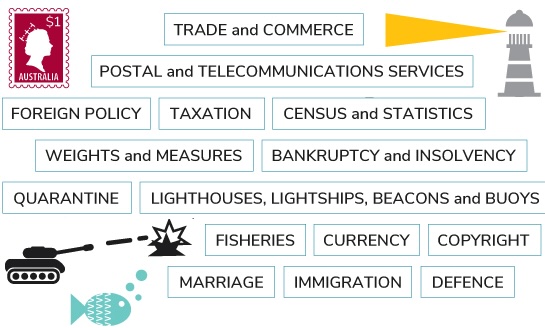
Now let's talk about how these two houses work together to make laws.
Law-making in the federal parliament
A proposed law is called a bill.
Bills are introduced into one of the two houses to be debated—usually the House of Representatives. If a majority of the members in that house vote to approve the bill, it is then introduced into the other house—usually the Senate, also known as the 'House of Review'.
A bill has to be approved by a majority of members in both houses before it can become a law.
Once the bill has passed both houses, the Governor-General of Australia must give their assent and sign the bill. Australia then has a new law.
Explore the Parliamentary Education Office to learn more about law-making in Australia.
Resources
Educational material about the three levels of government in Australia
Educational material about how federal laws are made
Learn about the role of the federal parliament and its two houses
Learn about how government works in Australia
Judith Brett presents a historical account of Australia's journey to compulsory voting and other electoral reforms
Edited by Amanda Dunn, this book talks about how democracy works in Australia and discusses Australia's political history
For younger readers, Annabel Crabb explains how Australian democracy works
State and Territory
Most Australian states have a bicameral parliament. This means that, like our Federal Parliament, they are made up of two houses.
The exception is Queensland, whose parliament consists of only one house. Two Australian territories—the Australian Capital Territory and the Northern Territory—also have a unicameral (single house) parliament.
Select an Australian parliament type below to learn more.
Bicameral state parliaments
The lower house in our bicameral state parliaments is either called the House of Assembly (Tasmania and South Australia) or the Legislative Assembly (Victoria, New South Wales and Western Australia). The upper house in each of these states is called the Legislative Council.
Let's talk about each of these houses.
House of Assembly/Legislative Assembly
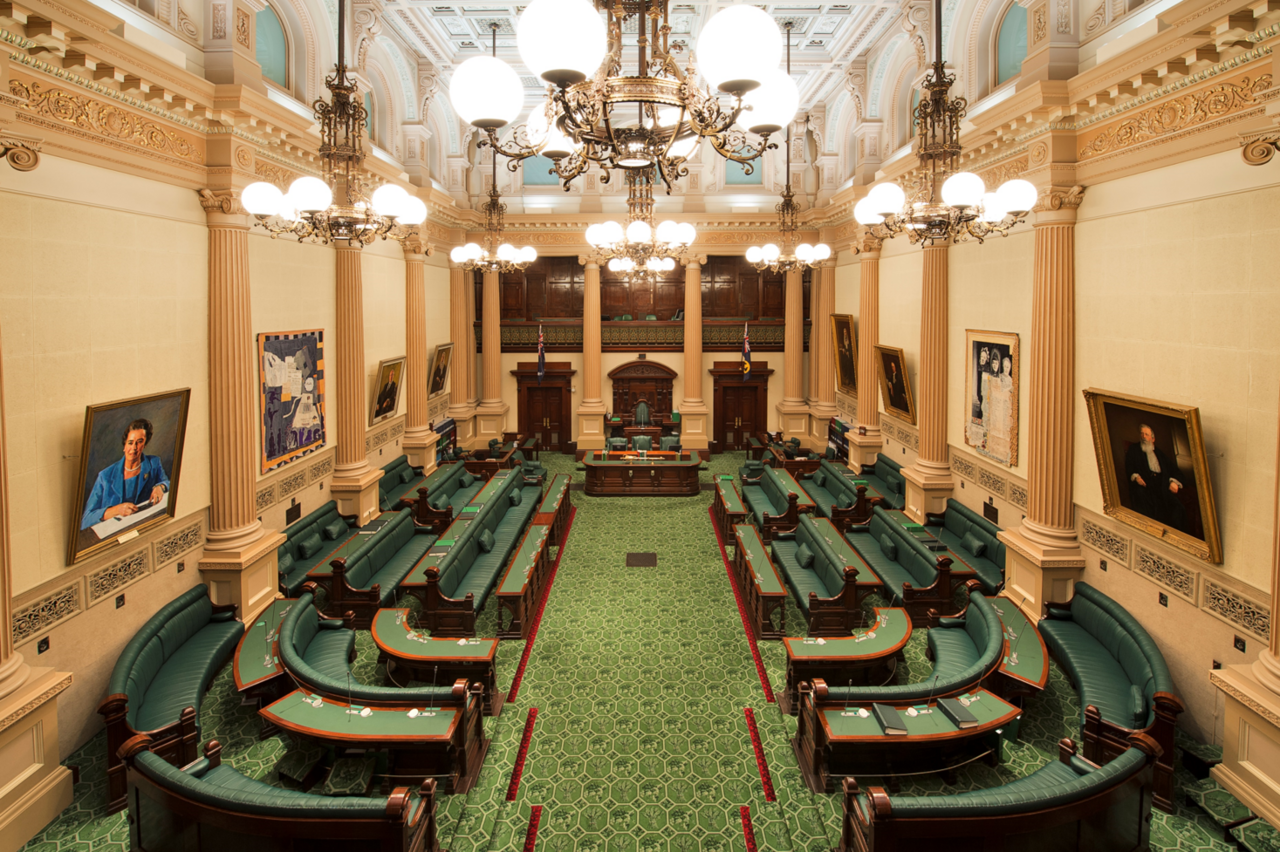
House of Assembly of South Australia. Parliament of South Australia, CC BY-SA 4.0.
These lower houses contain a certain number of seats. Each seat belongs to a single geographical region in the state called an electorate.
Each state holds an election every 4 years, where the voters in each electorate elect a candidate to sit in their seat in the lower house.
The political party or coalition that wins the majority of seats in the lower house forms the State Government.
Legislative Council
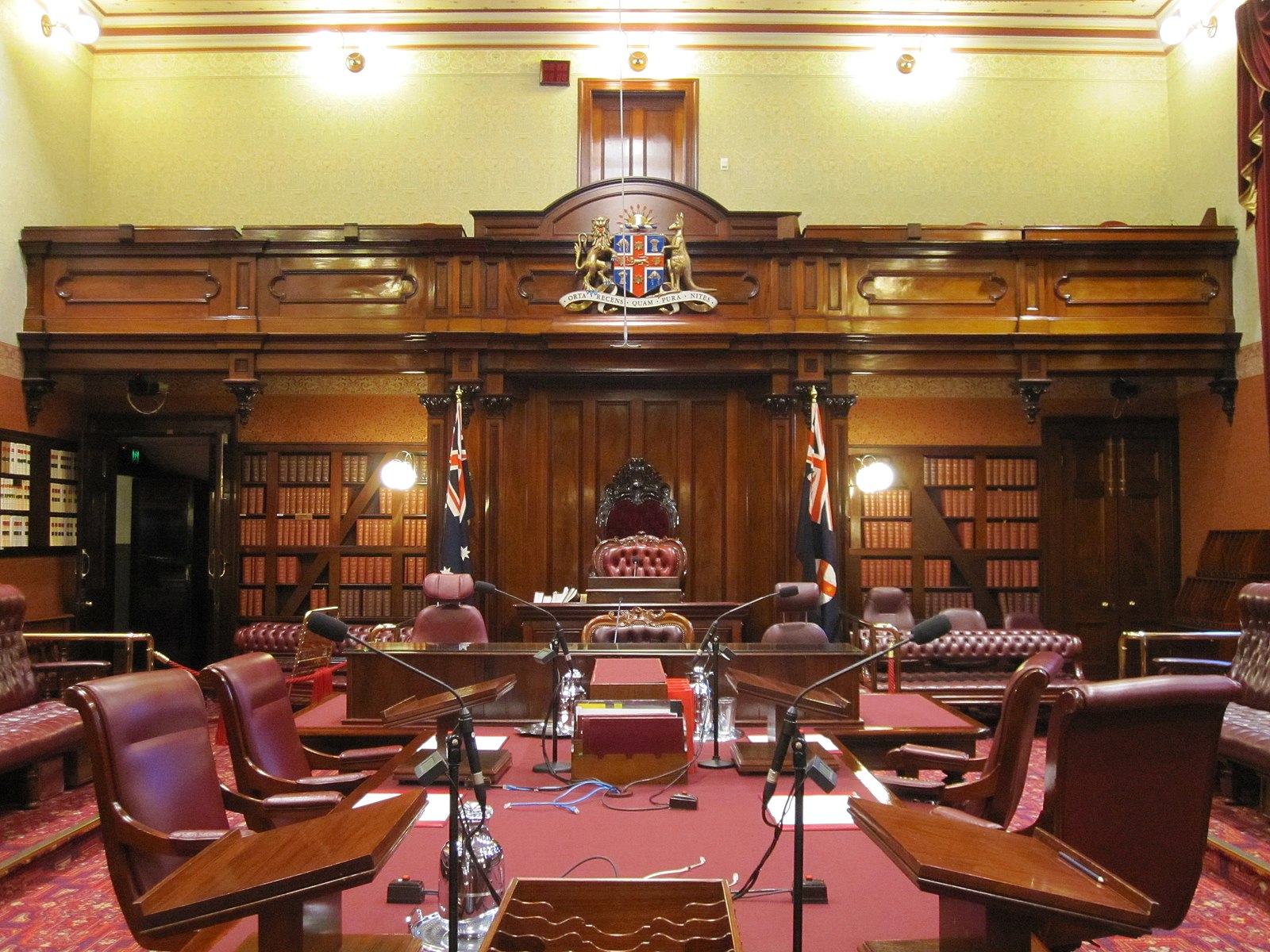
Legislative Council of New South Wales. Wikimedia Commons, Coekon, CC BY-SA 4.0.
The makeup of the Legislative Council in each of our states with bicameral parliaments differs.
The Victorian Legislative Council contains 40 seats, divided into 8 regions, with 5 candidates elected to represent that region. Each Victorian council member has a 4-year term. This means that every 4 years, Victorians elect a new set of candidates for both their lower and upper houses of parliament.
The Legislative Council in Western Australia is the only other state upper house with 4-year terms. In their Legislative Council, 37 council members are elected to represent the entire state.
This means that Western Australia is not divided up into regions or districts for upper house elections. All Western Australians vote to elect all 37 council members.
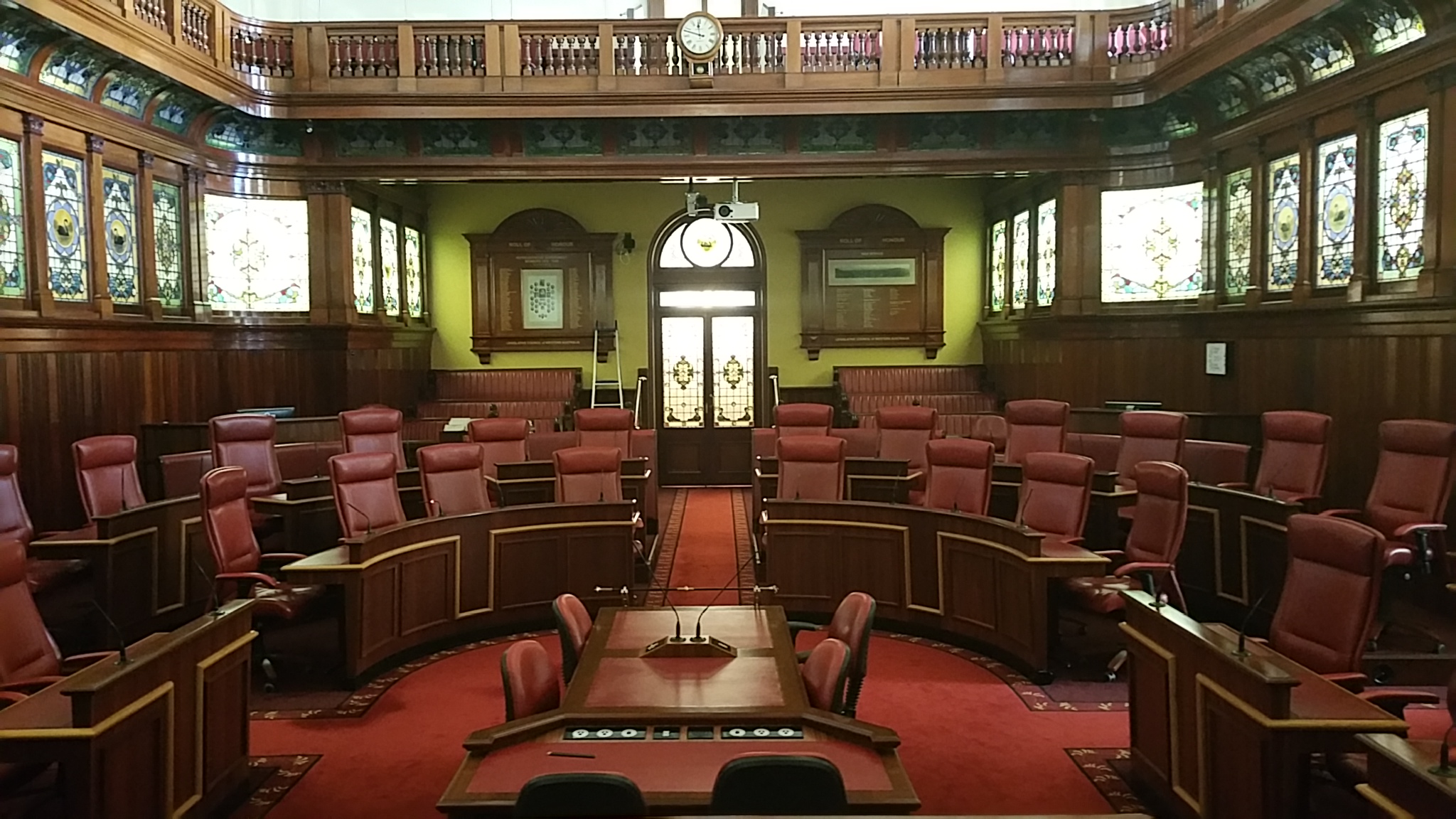
Legislative Council of Western Australia. Wikimedia Commons, Orderinchaos, CC BY-SA 4.0.
In the Legislative Councils of South Australia and New South Wales council members have 8-year terms. At each state election, held every 4-years, half of the seats in the Legislative Council are up for election. At the next state election, voters elect candidates to the remaining seats.
In both South Australia and New South Wales, each council member represents the entire state.
The Tasmanian Legislative Council is an interesting outlier. Their upper house contains 15 seats, with each seat associated with one of 15 districts. Council members are elected to 6-year terms.

The Parliament of Tasmania. Wikimedia Commons, Jorge Láscar, CC BY-2.0.
Unlike our other bicameral states, elections of candidates to the lower and upper houses are not aligned.
Elections for their lower house, the House of Assembly, occur every 4-years.
Tasmanians have a Legislative Council election every year in May. All 15 seats will be up for election across a 6-year cycle: 3 seats in the first year, 2 in the second, 3 in the third, 2 in the fourth, 3 in the fifth, and 2 in the sixth.
State parliaments have law-making powers in a range of areas, where each law applies within their state and not the rest of Australia.
State Responsibilities
The Australian Constitution outlines which areas fall within the law-making powers of State Parliaments. These include, but are not limited to schools, hospitals, public transport, policing, and utilities like electricity, water, and gas.
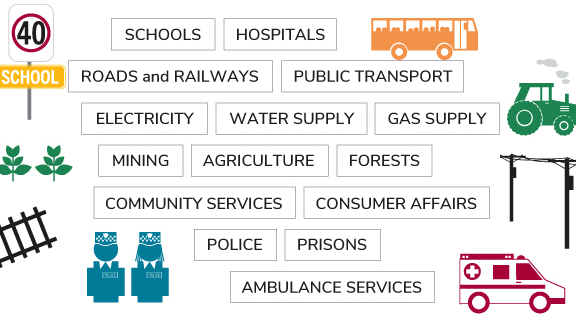
Law-making in our bicameral state parliaments proceeds in much the same was as it does in our Federal Parliament.
Law-making in Bicameral State Parliaments
Let's consider the Victorian Parliament as an example.
A proposed law is drafted in the form of a bill, which is introduced into one of the two houses. Generally, bills are introduced into the lower house—the Legislative Assembly—although they can be introduced into either house.
Once introduced to a house, it is read, debated, and voted on. If a bill is approved by a majority of members in the house, it passes, and is then introduced to the other house, usually the Legislative Council.
The bill is then read, debated, and voted on again. If the bill is passed in both houses, it proceeds to the Governor of Victoria who provides Royal assent. Only at this stage does the bill become a law.
Take a look at the Victorian Parliament website for more information on their law-making process.
The Parliament of Queensland
Let's now look at the unicameral parliament of Queensland.
The Queensland state parliament originally had two houses—a Legislative Assembly and a Legislative Council.
Its upper house, the Legislative Council, was abolished in 1922.
Queensland's Legislative Assembly has 93 seats, each representing a single electorate. Like all other Australian parliamentary lower houses, the party or coalition of parties that wins a majority of these seats in a state election forms the state government.
Queensland state elections occur every 4 years, as they do for all other Australian states and territories.
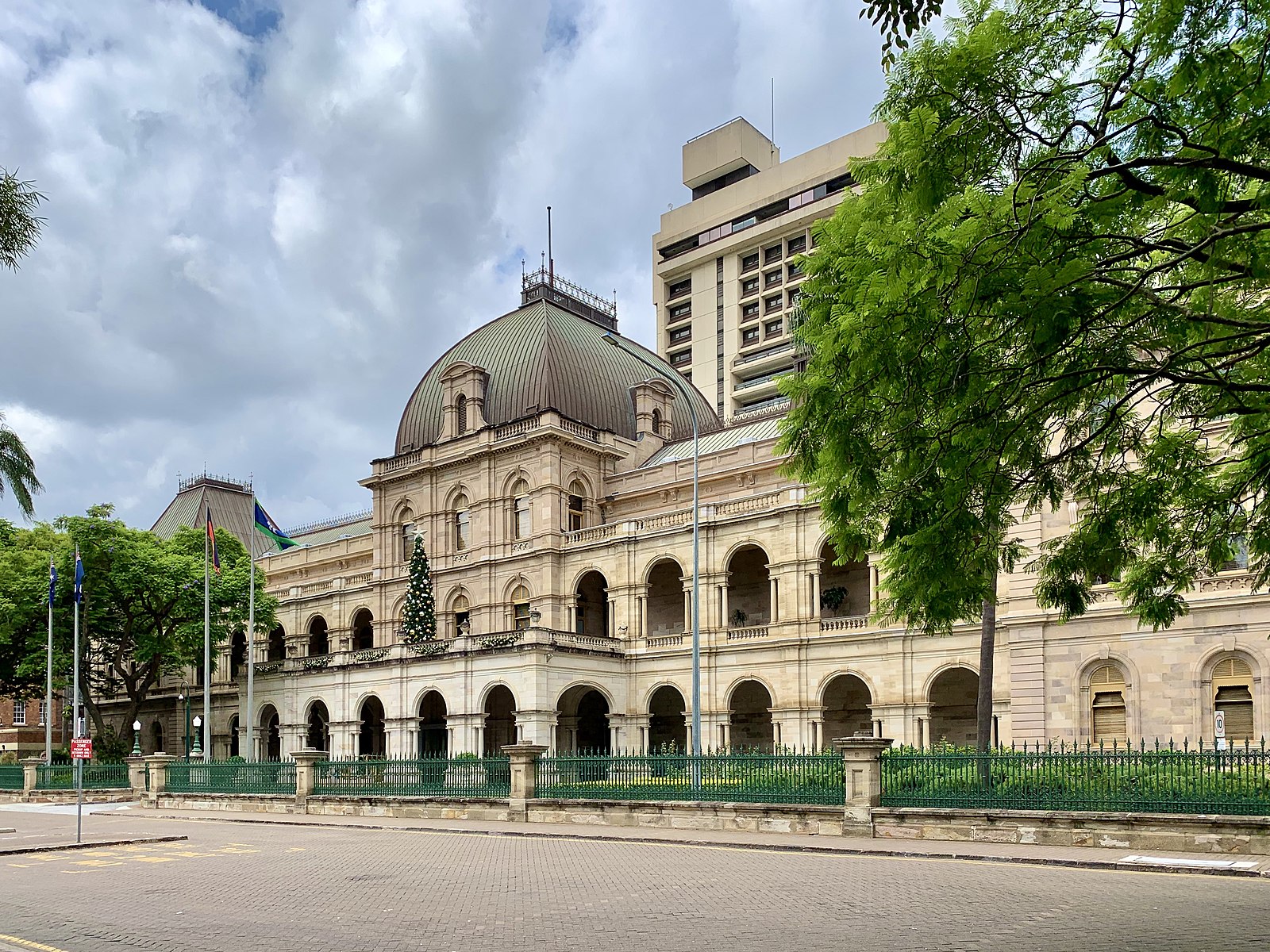
Parliament House in Brisbane, Queensland. Wikimedia Commons, Chris Olszewski, CC BY-SA 4.0.
The law-making powers of the Queensland parliament are the same as those of other states. Each law applies within the state of Queensland, and not the rest of Australia.
State Responsibilities
The Australian Constitution outlines which areas fall within the law-making powers of State Parliaments. These include, but are not limited to schools, hospitals, public transport, policing, and utilities like electricity, water, and gas.
The law-making process in the Queensland parliament differs from the process used in our bicameral parliaments.
With only a single house, bills that are introduced, debated, and passed in that house become laws after approval by the Governor of Queensland.
Visit the Queensland parliament's education and learning website to learn more about its history, structure, and legislative process.
The Territories
Australia has two territories with parliaments—the Australian Capital Territory (ACT) and the Northern Territory (NT).
The ACT and NT parliaments are unicameral, just like the Queensland state parliament. Like Queensland, the NT and ACT parliaments consist of a Legislative Assembly (lower house).
The ACT Legislative Assembly contains 25 seats. Law-making in the ACT parliament follows a slightly different process to that in the Queensland unicameral state parliament.
Bills introduced in the ACT Legislative Assembly are formed in collaboration with a body known as the Parliamentary Counsel's Office (PCO).
Once a bill is passed in the ACT's Legislative Assembly, a process of notification takes place. The bill is signed by the Clerk of the Assembly, and the PCO publishes the details of the new law on a public register.
Unlike our states, the ACT does not have a royal representative, such as a Governor, that provides royal assent to bills.
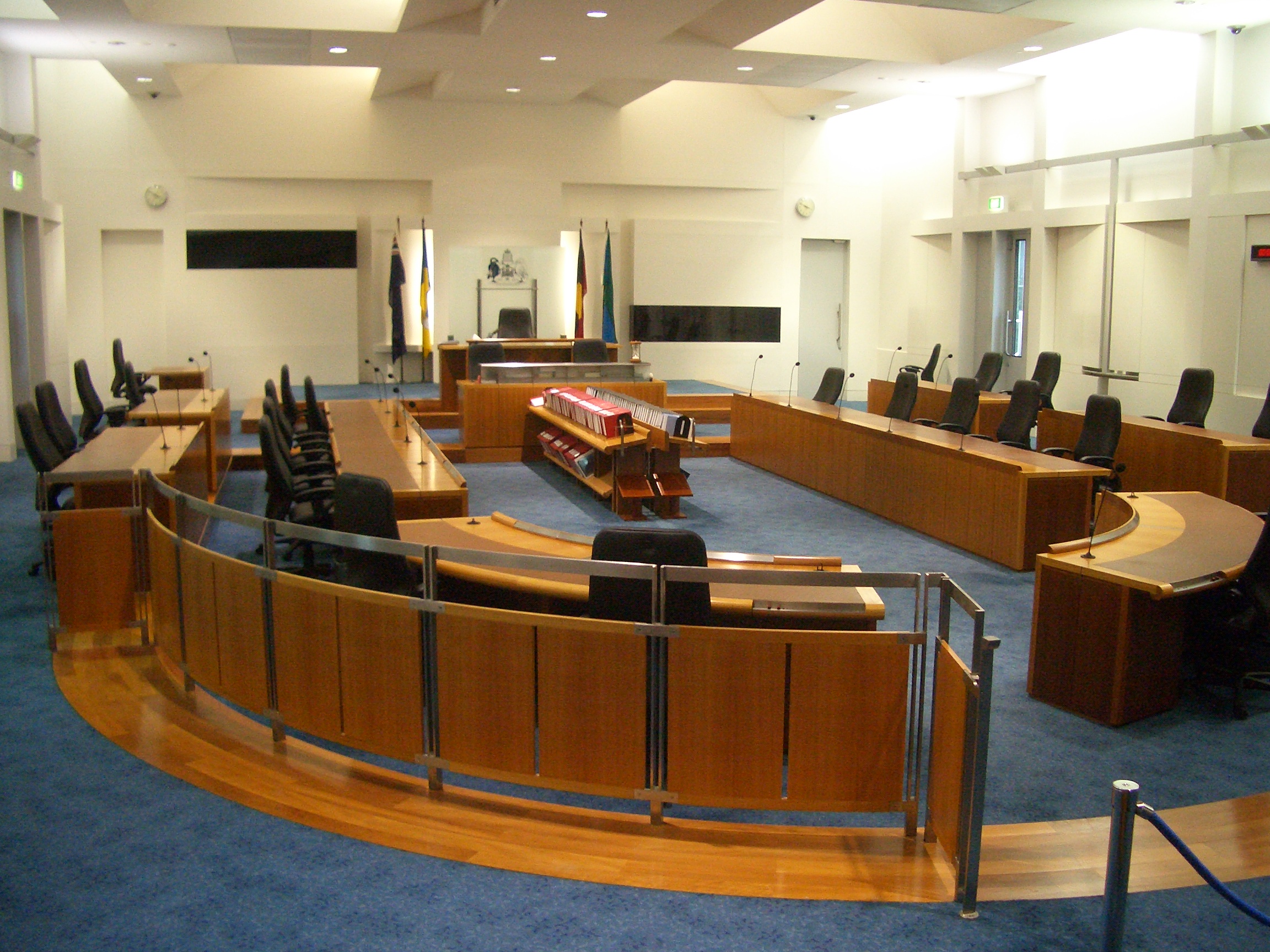
Legislative Assembly chamber of the ACT Parliament. Wikimedia Commons, LincoInite, public domain.
The NT Legislative Assembly also contains 25 seats. Law-making in the NT parliament is slightly different from that in the ACT.
Once a bill is passed in the Legislative Assembly, it must be approved by the NT Administrator to become law. Like state Governors, the NT Administrator is a representative of the Crown, and provides royal assent to passed bills.
The ACT and NT were given the power to self-govern only relatively recently (in the 1970s and 1980s). Prior to the Australian Capital Territory (Self-Government) Act of 1988, and the Northern Territory (Self-Government) Act of 1978, these two territories were managed by the federal government.
The NT did not have a Legislative Assembly until 1974, and this assembly was granted state-like legislative powers four years later in 1978. The ACT parliament was established as a result of the self-government act of 1988.
The ACT does not have local governments like our states do. This means that the ACT parliament is responsible for legislating on both state and local matters. Refresh your memory on state responsibilities below.
Refresher: State Responsibilities
The Australian Constitution outlines which areas fall within the law-making powers of State Parliaments. These include, but are not limited to schools, hospitals, public transport, policing, and utilities like electricity, water, and gas.
Take a sneak peek at what areas fall into the law-making responsibilities of local governments.
Sneak Peak: Local council responsibilities
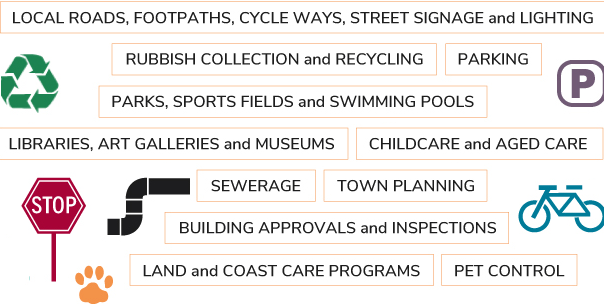
The NT does have local governments, and so the responsibilities of the NT parliament are much the same as those of our states.
While the ACT and NT are now self-governing, the federal government has the power to veto territory laws. As of 2011, however, a vote in the federal parliament is now required to do so.
Resources
Educational resource explaining the federal, state, and local levels of government
Website of the Parliament of the Australian Capital Territory
Website of the Parliament of the Northern Territory
Website of the Parliament of Queensland
Website of the Parliament of New South Wales
Website of the Parliament of Victoria
Website of the Parliament of Tasmania
Website of the Parliament of Western Australia
Website of the Parliament of South Australia
Local Government
Each Australian state, and most of its territories, have local governments to manage a range of services, including roads, rubbish collection, pet control, and sewerage.
Each council, municipality or shire is a local government, responsible for local matters for a specific region.
Smaller Australian territories, corresponding to a number of nearby islands, generally have one local government for the territory.
Local council responsibilities
Each local council consists of a varying number of councillors who are elected by the eligible voters within the council area.
Each council will have a mayor, generally elected by the councillors themselves, but sometimes by voters.
The frequency of council elections varies across states and territories.
In Victoria, council elections occur every 4 years, with councillors serving 4-year terms. In Western Australia, councillors serve 4-year terms, but council elections occur every 2 years. At each local election, candidates will be elected to half of the councillor positions.
The rules that govern council elections vary across states and territories.
Find out more about local elections in your area
Resources
National
An advocacy organisation that represents councils across Australia
Educational resource explaining the federal, state, and local levels of government
Victoria
Queensland
Western Australia
Find information about Western Australian local councils and their services
Western Australian Local Government Association representing WA councils
New South Wales
NSW government office providing oversight and support for local councils
Body representing NSW councils and local government interests
South Australia
Transparency and information portal for South Australian local councils
Information and resources about South Australian local government
Tasmania
Representative body for Tasmanian councils and local government
Information from the Tasmanian state government about local councils
Northern Territory
Australia pioneered the use of preferential voting.
We use this method to elect one candidate to each seat in the lower houses of our bicameral state and federal parliaments.
Preferential Voting
To start with, let's focus on elections where we need to elect a single candidate.
We use the term preferential voting, or ranked-choice voting, to describe elections where we rank or order candidates from most to least preferred.
To explain how preferential voting works, let's consider the fictional election of Top Bird in the Australian Bird Republic.
Preferential voting in action
Four candidates are vying for the role of Top Bird in the Australian Bird Republic.
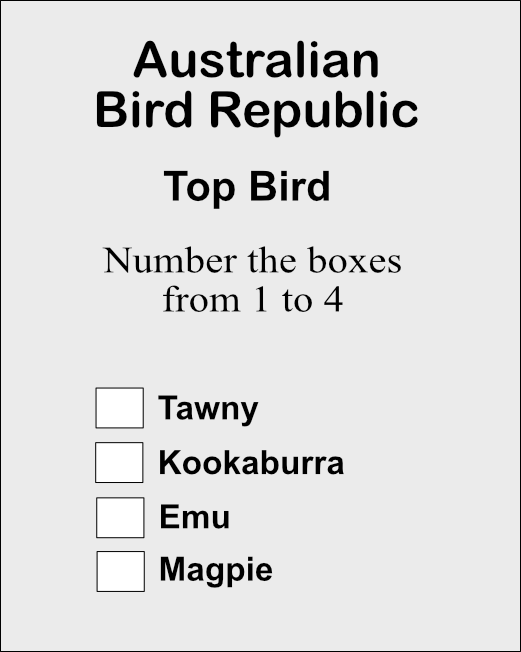
A total of 150 birds are eligible to vote in the Republic. Each bird is given a ballot paper, below, and must rank the candidates in order of preference, from 1 (most preferred) to 4 (least preferred).
A blank ballot paper
A cast ballot
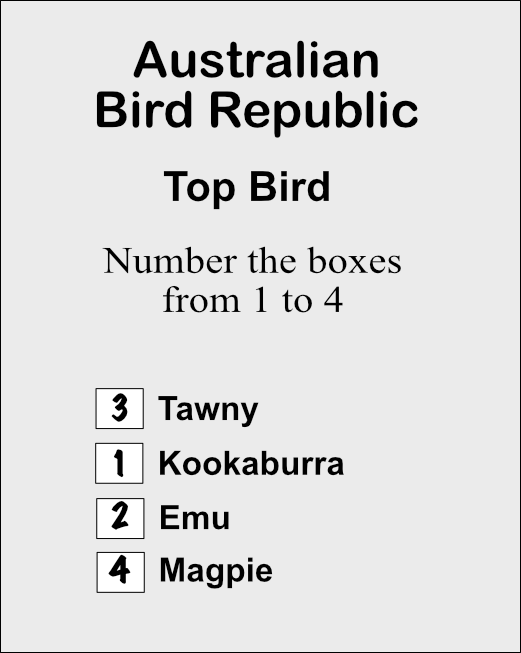
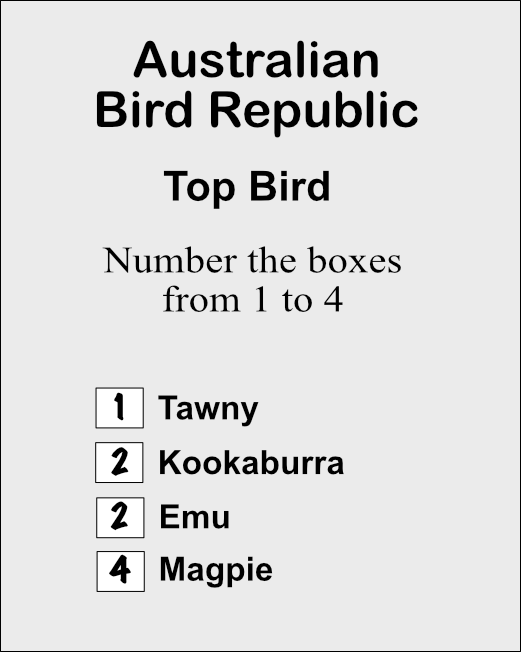
Each voter must put a number in every box, using the numbers 1 to 4 with no repeats, for their vote to be counted.
In this election, the following two ballots would be invalid.
Invalid ballot (repeated rank)
Invalid ballot (missing ranks)
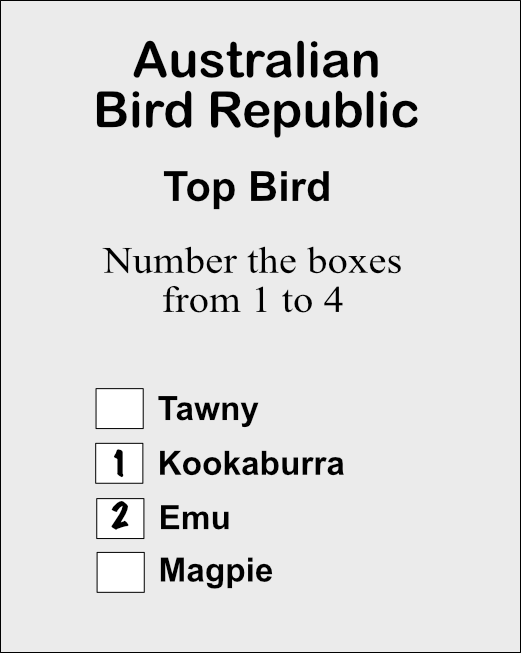
Our state, territory and national electoral commissions define the rules for filling out ballot papers in our elections. When voting in an election, it is important to familiarise yourself with how to properly cast your vote to make sure that it is valid. In Australian elections, invalid votes are called informal.
Of the 150 eligible voters in the Australian Bird Republic, 140 of them cast a valid vote, with 10 birds casting an invalid vote.
To determine which candidate is the winner, the Australian Bird Republic uses the same method that is used in real-world Australian preferential elections.
To start with, each candidate is given all the ballots on which they have been ranked first. The number of ballots a candidate has represents their initial tally. Each ballot is worth 1 vote.
The initial tallies of each Top Bird candidate are shown below.
Ballots containing the same ordering over candidates have been stacked into a pile, and placed to the right of the candidate ranked first on those ballots.
The number of ballots in each stack is displayed on its bottom-right corner. The total number of votes in each candidates' tally is shown on the far-right.
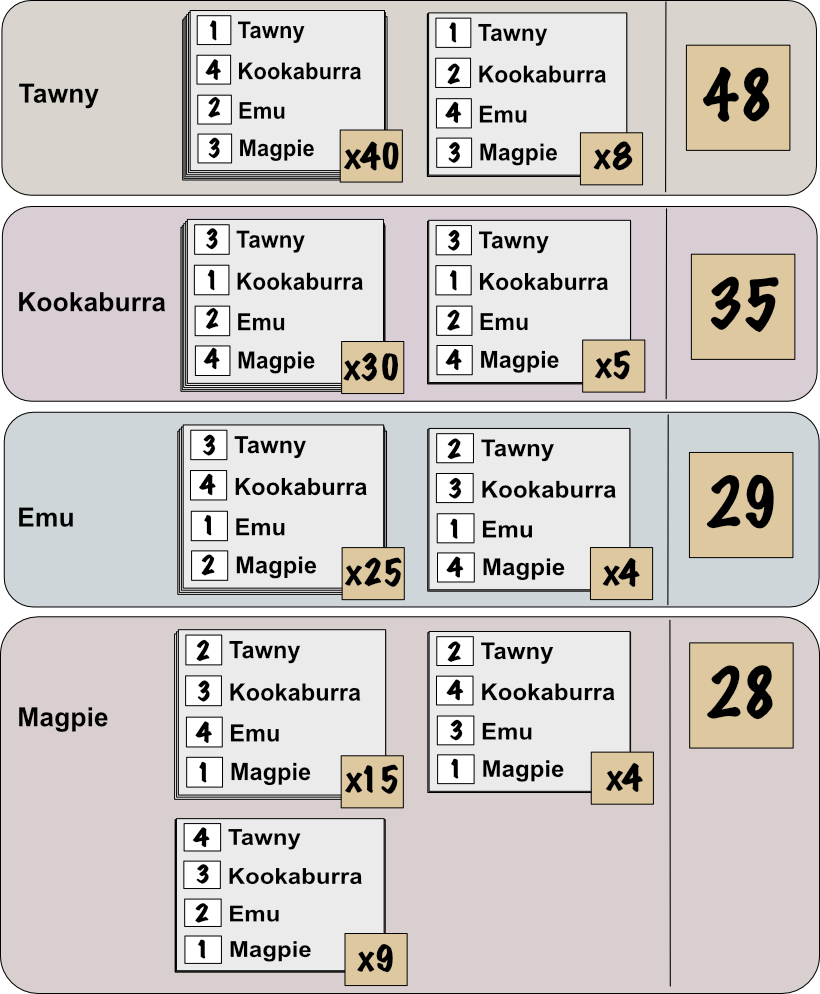
The Kookaburra has 35 votes: 30 with the ranking Kookaburra, Emu, Tawny, Magpie and 5 with the ranking Kookaburra, Emu, Tawny, Magpie.
The Emu has 29 votes: 25 with the ranking Emu, Magpie, Tawny, Kookaburra and 4 with the ranking Emu, Tawny, Kookaburra, Magpie.
The Magpie has 28 votes: 15 with the ranking Magpie, Tawny, Kookaburra, Emu, 4 with the ranking Magpie, Tawny, Emu, Kookaburra, and 9 with the ranking Magpie, Emu, Kookaburra, Tawny.
We then repeat the following step until one candidate has more than 50 percent of the total number of validly cast votes, or there are only two candidates left. In both cases, the candidate with the highest tally is declared the winner.
In the Top Bird contest, the Magpie has the smallest tally at 28 votes. They are removed from the contest, and out of the running for Top Bird.
There are three types of ballots in their tally. They have 15 ballots with the ranking Magpie, Tawny, Kookaburra, Emu, 4 ballots with the ranking Magpie, Tawny, Emu, Kookaburra and 9 ballots with the ranking Magpie, Emu, Kookaburra, Tawny.
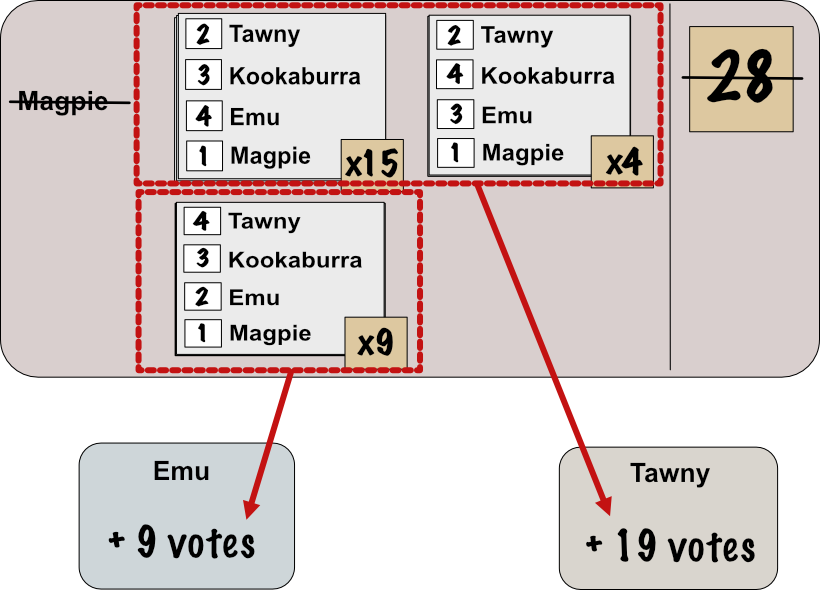
The 19 ballots with the Tawny as the next-highest-ranked candidate go to the Tawny, while the 9 ballots whose second preference is the Emu go to the Emu.
The candidates' tallies now look like this:
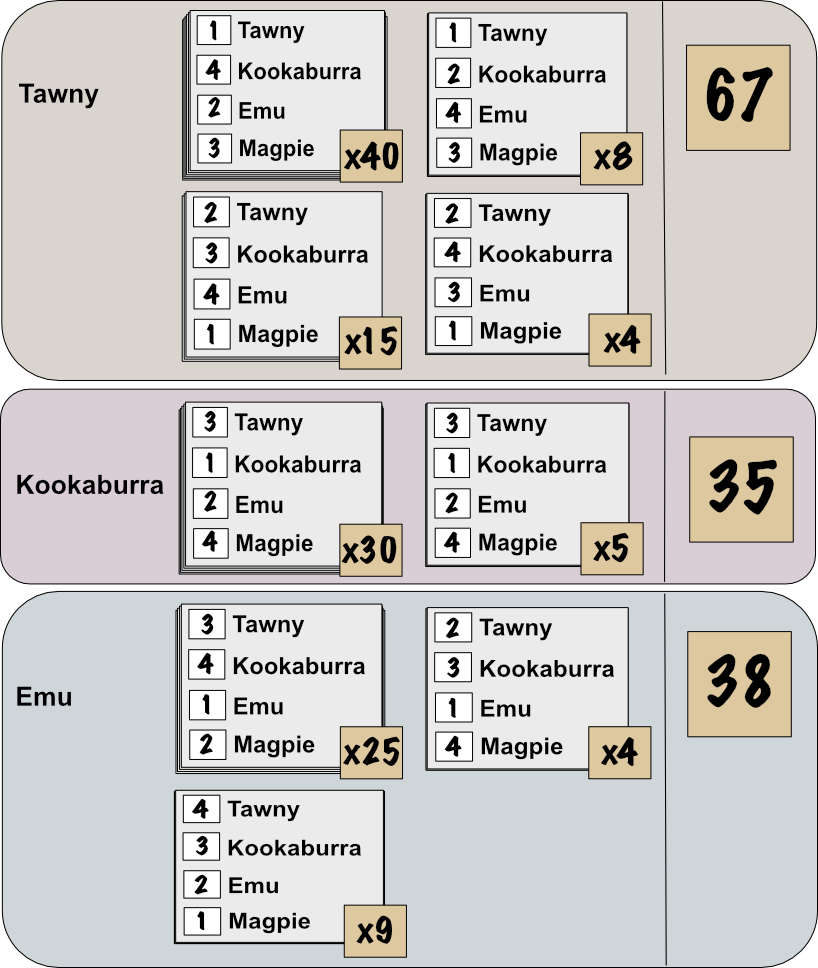
The Kookaburra still has 35 votes, receiving no ballots from the Magpie.
The Emu now has 38 votes, up from 29, receiving 9 votes with the ranking Magpie, Emu, Kookaburra, Tawny from the Magpie.
The Magpie is no longer in the running for Top Bird.
At this point, no candidate has more than 50 percent of the total vote (70 votes).
We repeat the step of removing a candidate from the contest. The Kookaburra has the smallest tally at 35 votes, and is removed from the contest.
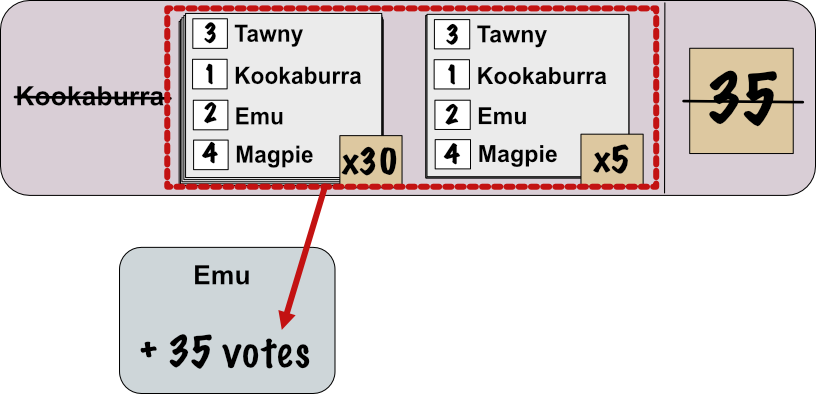
All the ballots sitting in the Kookaburra's tally piles have the Emu as their second preference. The Emu receives these 35 votes when the Kookaburra is removed from the contest.
The candidates' tallies now look like this:
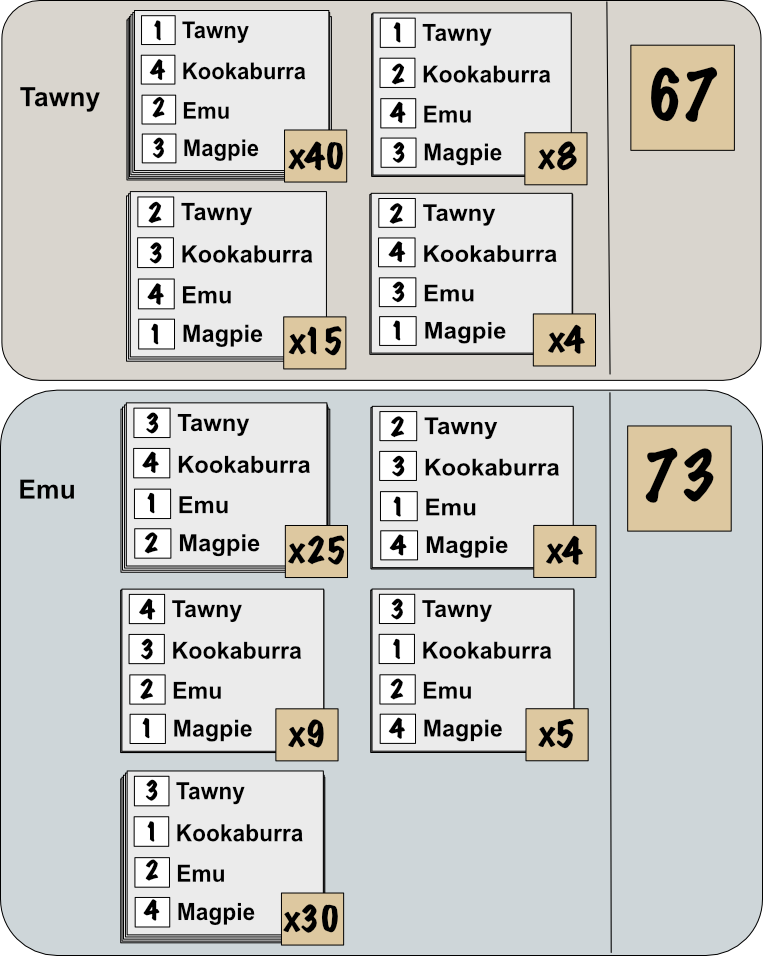
The Emu now has 73 votes, up from 38, receiving 30 votes with the ranking Kookaburra, Emu, Tawny, Magpie and 5 votes with the ranking Kookaburra, Emu, Tawny, Magpie from the Kookaburra.
The Kookaburra and Magpie are no longer in the running for Top Bird.
We now have met both stopping conditions. With 73 votes to the Tawny's 67, the Emu is declared the winner!
Let's now summarise the steps of the counting process.
One might wonder why we have two stopping conditions. Why is it that can we stop the count once a candidate accumulates more than 50 percent of the validly cast votes? Well, the answer is that at this point, there is no way that another candidate could possibly win.
If the Emu has more than 50 percent of the vote, it means that the total number of votes sitting in the tally piles of other candidates is less than 50 percent. Even if another candidate was to gather all of these votes, they would still have less than 50 percent, and fewer votes than the Emu.
We've looked at preferential voting in the context of a fictional election. How does all of this relate to Australian elections?
Australian elections and preferential voting
What we have described on this page so far is a way of voting and counting known more technically as Instant Runoff Voting.
In Australian local, state/territory, and federal elections, we cast our votes on pieces of paper.
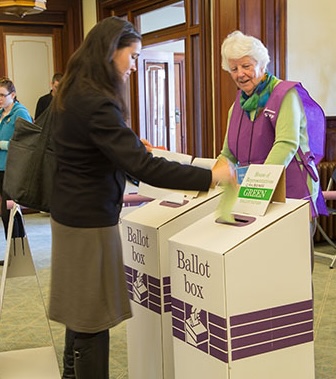
Casting a vote in the 2016 Austalian federal election for the House of Representatives (green paper ballot). Wikimedia Commons, Australian Electoral Commission, CC BY 3.0.
We typically always perform the counting process by hand for our single-winner elections.
This is the case, for example, when we elect a single candidate to each seat in the House of Representatives—the lower house of our federal parliament.
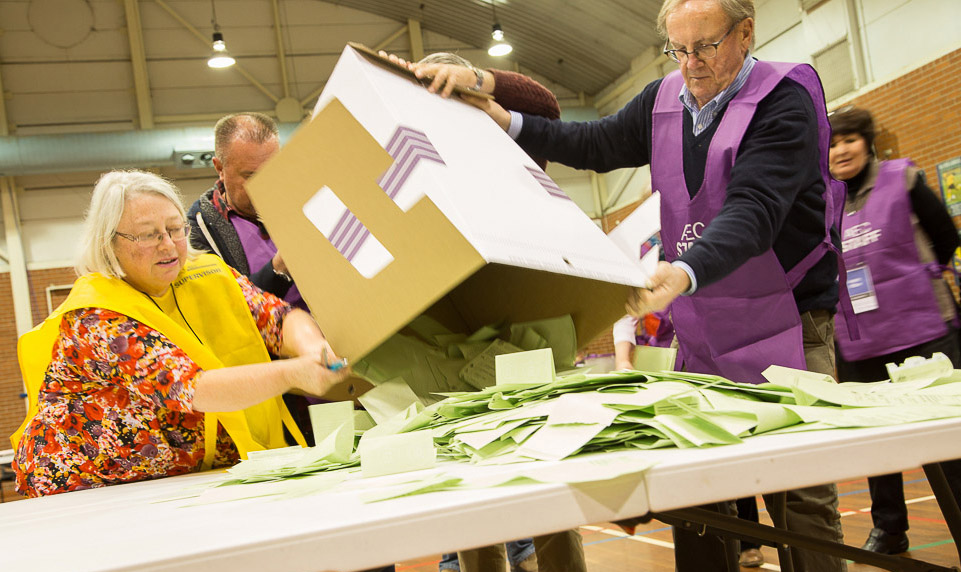
Opening a ballot box, 2016 Australian federal election (House of Representatives), Wikimedia Commons, Australian Electoral Commission, CC BY 3.0.
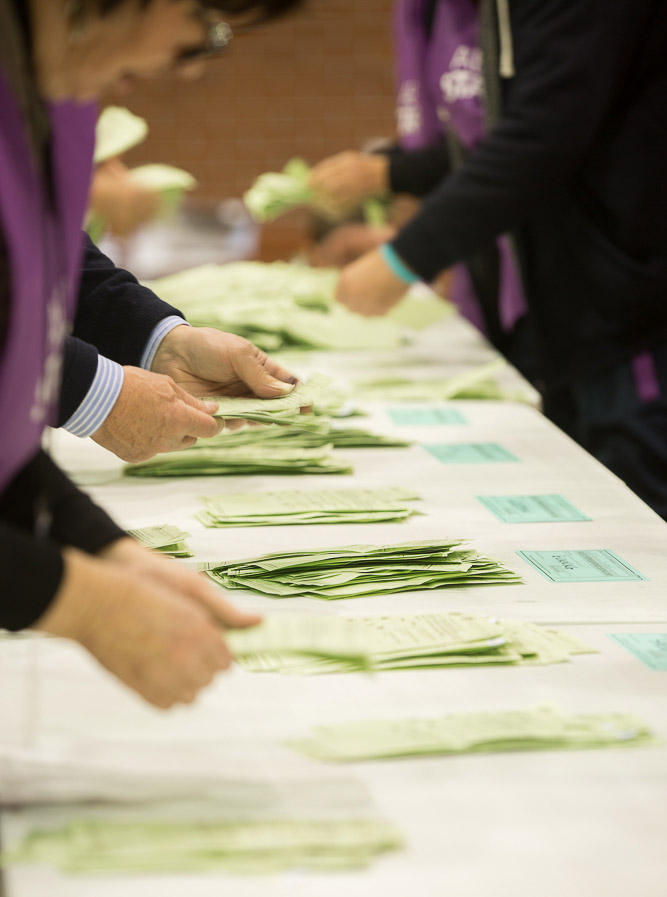
Sorting ballots, 2016 Australian federal election (House of Representatives), Wikimedia Commons, Australian Electoral Commission, CC BY 3.0.
Earlier, we described the process of counting votes in a preferential election. This process progressively removes candidates from the contest until we have a clear winner.
We provide a summary of the counting process, below, to refresh your memory.
Counting process: A summary
To identify the winner of a preferential election, we first give each candidate all the ballots on which they have been ranked first.
We then repeatedly identify the candidate with the smallest number of votes, remove them from the contest, and give their votes to candidates that are still in the contest.
We repeat this last step until one candidate has more than 50 percent of the total number of validly cast votes, or there are two candidates left. At this point, the candidate with the most votes is declared the winner.
If we execute this process until the very end, when we have found the winner, we have performed what we call a full distribution of preferences.
Election officials can't start doing the full distribution of preferences until they have all the ballots cast by voters. This includes ballots that are sent in by post. Electoral commissions must wait for a certain period of time after election day—a matter of weeks—to allow for postal ballots to arrive.
If it takes our electoral commissions weeks to complete the full distribution of preferences for our preferential elections, then why do we often know the outcome on election night?
This is where something called the Two Party Preferred count, TPP, or Two Candidate Preferred count, TCP, comes in.
Preferential Proportional Voting
For the majority of Australian elections where we want to elect multiple candidates, we use a preferential and proportional voting system.
Multiple candidates are elected from each state and territory to fill the 76 seats of the Australian Senate, for example.
The idea behind proportional voting systems is that the number of seats each political party wins is proportional to the amount of votes they receive.
The technical name for the voting system used in these kinds of elections across Australia is the Single Transferable Vote.
The way that votes are counted in a Single Transferable Vote election varies slightly across our states and territories, and for elections at the federal and local government levels. The general idea is the same, but there are little differences in the details.
For now, we'll keep our focus on the Australian Senate.
We'll start with a brief, non-technical overview of how Australian Senate counting works.
Australian Senate counting in brief
The 76-seat Australian Senate is the upper house of the Australian federal parliament.
To learn about the role of the Senate in the creation of federal laws, have a look at our topic on law-making in the federal parliament.
Australian Senate, Wikimedia Commons, JJ Harrison, CC BY-SA 3.0.
After the 2025 Australian Federal election, the allocation of seats to parties in the Australian Senate can be visualised as shown below.
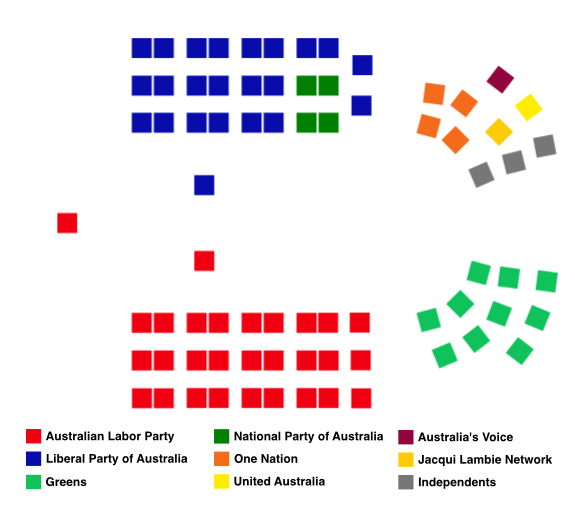
Wikimedia Commons, Princess Pandora, Public Domain.
Before we look at the results of this election in each state and territory, let's talk about how we vote in Australian Senate elections, and how candidates win seats.
Voting in Australian Senate elections
When voting in an Australian Senate election we get a ballot that looks something like this:
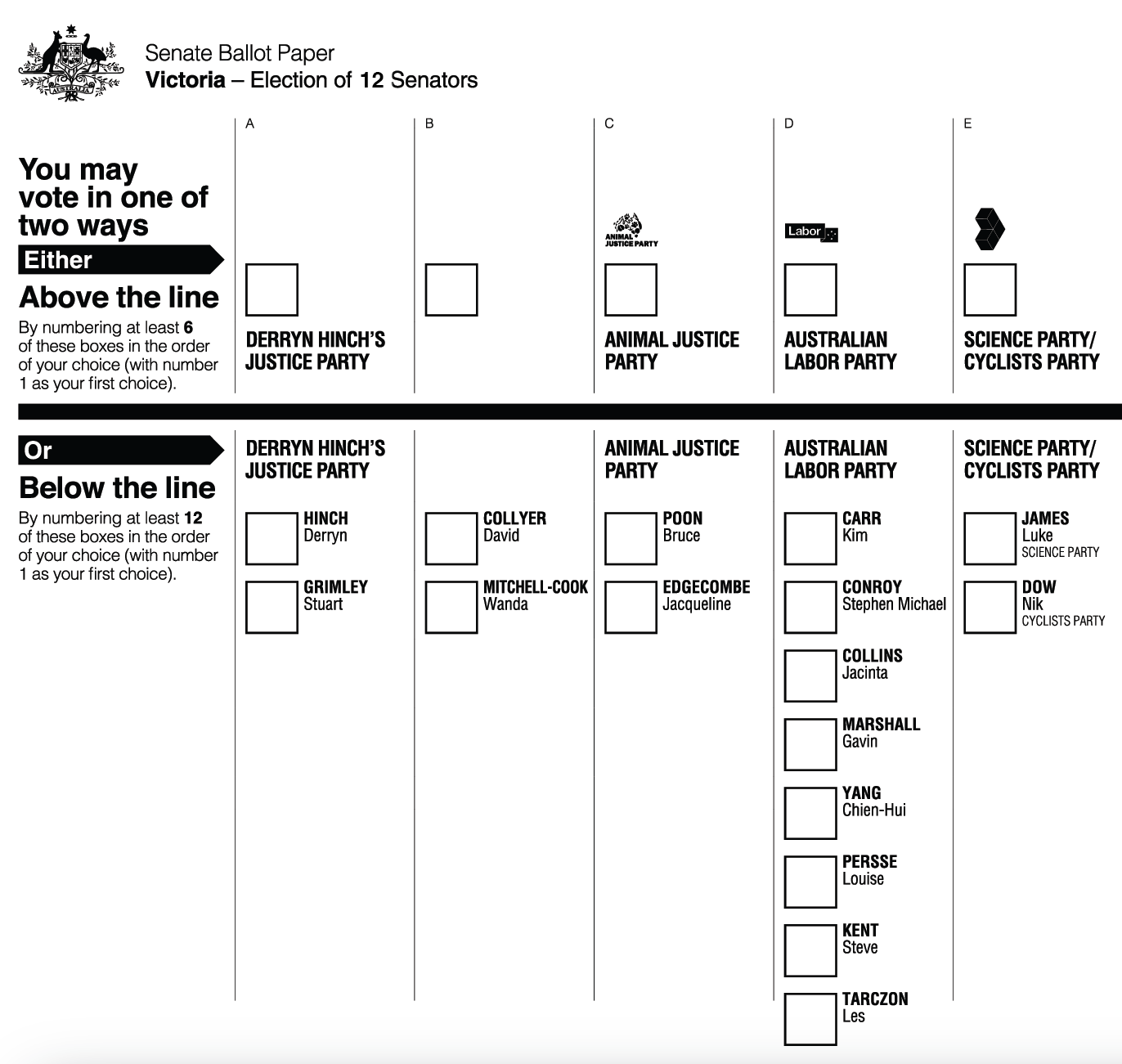
Wikimedia Commons, Santwyne, CC BY 4.0.
The image above shows a section of an Australian Senate ballot for a Victorian voter in the 2016 Australian Federal election. The full ballot had 40 columns. The image above shows only the first 5 of these.
Each column represents a party or group of candidates.
We fill out the ballot in one of two ways. We can either vote above the line or below the line.
Voting above the line
When we vote above the line, we rank parties or groups of candidates by writing numbers in the boxes that sit above the line, as shown below for a fictional election. In this election we have 6 weather-based parties.
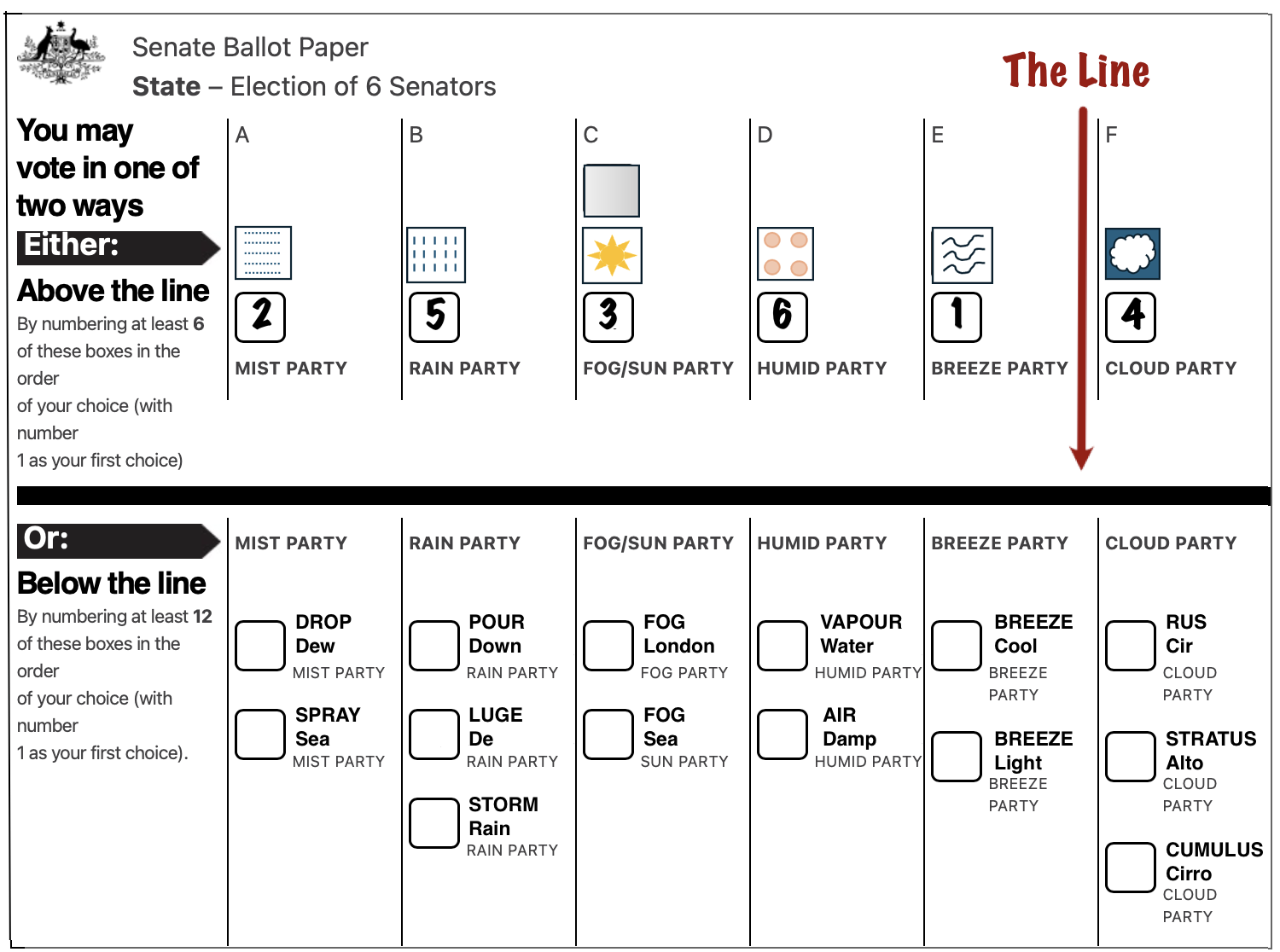
AEC, ©Commonwealth of Australia 2017, CC BY 4.0, modified for size, with added party logos, candidate names, rankings, and an arrow pointing to 'The Line'.
The voter has ranked the Breeze Party as their most preferred with rank 1. The Mist Party is the next most preferred with rank 2. The Fog/Sun, Cloud, Rain, and Humid Parties are ranked 3 to 6 in that order.
This ballot says that the voter prefers all candidates in the Breeze Party over the candidates in all other parties. The next most preferred set of candidates are the ones in the Mist Party. The Mist Party candidates are preferred over all candidates in the Fog/Sun, Cloud, Rain, and Humid Parties. The Fog/Sun, Cloud, Rain, and Humid Party candidates are the next most preferred in that order.
If we were to express this above the line vote as a preference ranking over individual candidates, it would look like this:
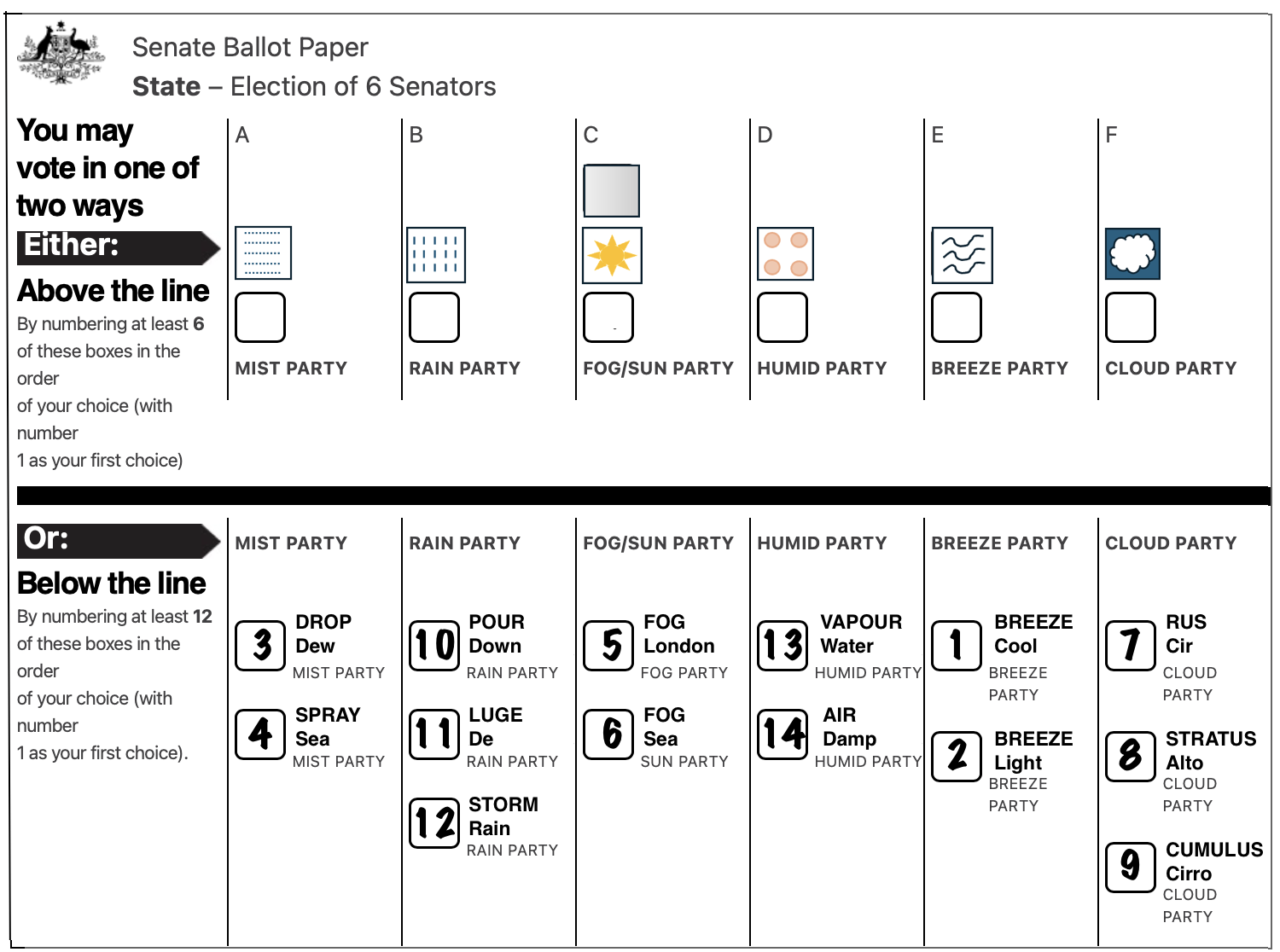
AEC, ©Commonwealth of Australia 2017, CC BY 4.0, modified for size, with added party logos, ranks, and candidate names.
You can practise filling out a sample ballot on the Australian Electoral Commission website.
Voting below the line
Sometimes we do have a preference order over the candidates in each party. For example, a voter might prefer Sea SPRAY from the Mist Part the most. If they voted above the line, they wouldn't be able to express this preference as Sea SPRAY is not the first listed candidate in the Mist Party. In this case, the voter can vote below the line and specify the order in which they prefer each candidate.
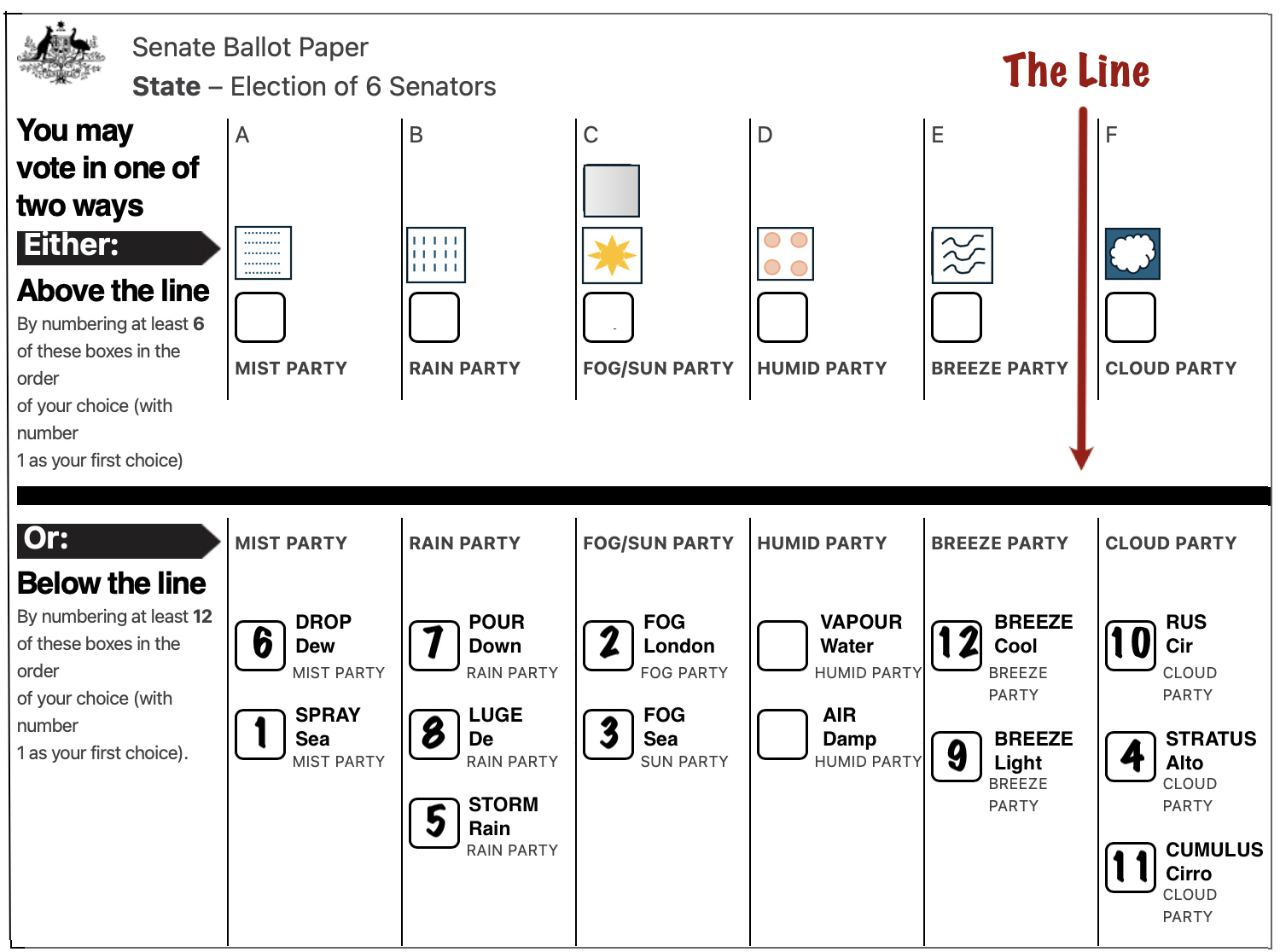
AEC, ©Commonwealth of Australia 2017, CC BY 4.0, modified for size, with added party logos, candidate names, ranks, and an arrow pointing to 'The Line'.
When voting below the line in an Australian Senate election, the voter must rank at least 12 candidates in order of preference, from 1 (most preferred) to 12.
On the above ballot, the voter ranks the candidates in the following order, from most to least preferred: Sea SPRAY, London FOG, Sea FOG, Alto STRATUS, Rain STORM, Dew DROP, Down POUR, De LUGE, Light BREEZE, Cir RUS, Cirro CUMULUS, and Cool BREEZE.
You can practise filling out a sample ballot on the Australian Electoral Commission website.
How candidates win Senate seats
Each state and mainland territory has 2 to 12 seats for their representatives in the Senate. The Northern Territory and the Australian Capital Territory have 2 senators, while each state has 12. In most federal elections only half of the 12 Senate seats for each state are up for election.
The voters in each state and territory will decide who wins their share of the seats in the Senate.
To win a seat, a candidate needs to gather enough votes to reach a threshold called the quota. This threshold depends on the number of valid votes cast in the given state or territory, and the number of seats that need to be filled.
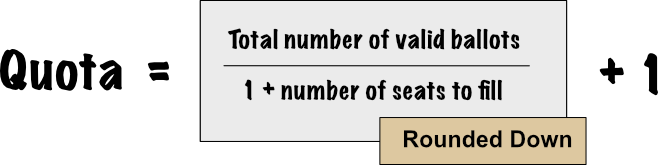
We divide the total number of validly cast ballots by one plus the number of seats we need to fill. We round down the resulting fractional value to an integer, and we add one to the result to get the quota.
All the candidates will start out with all the votes where they have been ranked number 1, and if they are the first candidate in their party, all the votes where their party has been ranked number 1.
A detailed step-by-step explanation of the counting process appears in a later topic. The gist is that when candidates are elected, we pass their votes on to the next most preferred candidates on the ballots. But, these votes won't be worth as much as they have already been used to elect a candidate.
If the tallies of all candidates are below the quota, then the candidate with the smallest tally is removed or excluded. Their votes will also move on to later preferences on the ballots. We don't change how much they are worth in this case as they haven't yet helped a candidate get elected.
We keep electing and eliminating candidates until we have filled all the available seats.
Let's now have a deeper look at the results of the 2025 Australian Senate election.
Queensland
The quota for Queensland in 2025 was 460,634 votes.
For each party that won a seat in this election, the table below shows how many first preference votes they or their candidates received (Votes).
We also show how many seats they won (Seats Won), and how many quotas were in their first preference tally (Quotas).
| Party | Votes | Seats Won | Quotas |
|---|---|---|---|
| Liberal Party and Nationals (LNP) | 997,404 | 2 | 2.1653 |
| Australian Labor Party (ALP) | 982,811 | 2 | 2.1336 |
| Greens (GRN) | 337,746 | 1 | 0.7332 |
| One Nation (ON) | 229,746 | 1 | 0.4988 |
The number of seats a party won is roughly in line with how many quotas worth of votes its candidates received.
If we round down the number of quotas a party received, they will generally get that number of seats, with any additional seat dependent on preference flows from other parties heading their way.
New South Wales
The quota for New South Wales in 2025 was 712,405 votes.
For each party that won a seat in this election, the table below shows how many first preference votes they or their candidates received (Votes).
We also show how many seats they won (Seats Won), and how many quotas were in their first preference tally (Quotas).
| Party | Votes | Seats Won | Quotas |
|---|---|---|---|
| Australian Labor Party (ALP) | 1,876,713 | 2 | 2.6343 |
| Liberal Party and Nationals (LNP) | 1,467,940 | 2 | 2.0605 |
| Greens (GRN) | 557,610 | 1 | 0.7827 |
| One Nation (ON) | 302,438 | 1 | 0.4245 |
The number of seats a party won is roughly in line with how many quotas worth of votes its candidates received.
If we round down the number of quotas a party received, they will generally get that number of seats, with any additional seat dependent on preference flows from other parties heading their way.
Australian Capital Territory
The quota for the Australian Capital Territory in 2025 was 97,825 votes.
For each party that won a seat in this election, the table below shows how many first preference votes they or their candidates received (Votes).
We also show how many seats they won (Seats Won), and how many quotas were in their first preference tally (Quotas).
| Party | Votes | Seats Won | Quotas |
|---|---|---|---|
| David Pocock (IND) | 114,915 | 1 | 1.1747 |
| Australian Labor Party (ALP) | 93,135 | 1 | 0.9521 |
The number of seats a party won is roughly in line with how many quotas worth of votes its candidates received.
If we round down the number of quotas a party received, they will generally get that number of seats, with any additional seat dependent on preference flows from other parties heading their way.
Victoria
The quota for Victoria in 2025 was 585,967 votes.
For each party that won a seat in this election, the table below shows how many first preference votes they or their candidates received (Votes).
We also show how many seats they won (Seats Won), and how many quotas were in their first preference tally (Quotas).
| Party | Votes | Seats Won | Quotas |
|---|---|---|---|
| Australian Labor Party (ALP) | 1,422,364 | 3 | 2.4274 |
| Liberal Party and Nationals (LNP) | 1,288,356 | 2 | 2.1987 |
| Greens (GRN) | 510,835 | 1 | 0.8718 |
The number of seats a party won is roughly proportional to how many quotas worth of votes its candidates received. The parties that won a seat, but didn't have a quota initially, built up a quota by getting votes from winning and losing candidates.
Tasmania
The quota for Tasmania in 2025 was 53,113 votes.
For each party that won a seat in this election, the table below shows how many first preference votes they or their candidates received (Votes).
We also show how many seats they won (Seats Won), and how many quotas were in their first preference tally (Quotas).
| Party | Votes | Seats Won | Quotas |
|---|---|---|---|
| Australian Labor Party (ALP) | 130,967 | 2 | 2.4658 |
| Liberal Party and Nationals (LNP) | 87,514 | 2 | 1.6477 |
| Greens (GRN) | 60,650 | 1 | 1.1419 |
| Jacqui Lambie Network | 27,055 | 1 | 0.5094 |
The number of seats a party won is roughly in line with how many quotas worth of votes its candidates received.
If we round down the number of quotas a party received, they will generally get that number of seats, with any additional seat dependent on preference flows from other parties heading their way.
Northern Territory
The quota for the Northern Territory in 2025 was 35,603 votes.
For each party that won a seat in this election, the table below shows how many first preference votes they or their candidates received (Votes).
We also show how many seats they won (Seats Won), and how many quotas were in their first preference tally (Quotas).
| Party | Votes | Seats Won | Quotas |
|---|---|---|---|
| Australian Labor Party (ALP) | 37,351 | 1 | 1.0491 |
| Country Liberal Party (CLP) | 34,954 | 1 | 0.9818 |
The number of seats a party won is roughly in line with how many quotas worth of votes its candidates received.
If we round down the number of quotas a party received, they will generally get that number of seats, with any additional seat dependent on preference flows from other parties heading their way.
South Australia
The quota for South Australia in 2025 was 166,297 votes.
For each party that won a seat in this election, the table below shows how many first preference votes they or their candidates received (Votes).
We also show how many seats they won (Seats Won), and how many quotas were in their first preference tally (Quotas).
| Party | Votes | Seats Won | Quotas |
|---|---|---|---|
| Australian Labor Party (ALP) | 442,995 | 3 | 2.6639 |
| Liberal Party of Australia | 320,932 | 2 | 1.9299 |
| Greens (GRN) | 150,148 | 1 | 0.9029 |
The number of seats a party won is roughly in line with how many quotas worth of votes its candidates received.
If we round down the number of quotas a party received, they will generally get that number of seats, with any additional seat dependent on preference flows from other parties heading their way.
Western Australia
The quota for Western Australia in 2025 was 231,717 votes.
For each party that won a seat in this election, the table below shows how many first preference votes they or their candidates received (Votes).
We also show how many seats they won (Seats Won), and how many quotas were in their first preference tally (Quotas).
| Party | Votes | Seats Won | Quotas |
|---|---|---|---|
| Australian Labor Party (ALP) | 586,692 | 3 | 2.5319 |
| Liberal Party of Australia | 431,607 | 2 | 1.8626 |
| Greens (GRN) | 208,327 | 1 | 0.8991 |
| One Nation (ON) | 95,230 | 1 | 0.4110 |
The number of seats a party won is roughly in line with how many quotas worth of votes its candidates received.
If we round down the number of quotas a party received, they will generally get that number of seats, with any additional seat dependent on preference flows from other parties heading their way.
For a detailed step-by-step explanation of how preferential proportional elections, like our Australian Senate, are counted, let's revisit the Australian Bird Republic.
Preferential proportional voting in detail
The national parliament of the Australian Bird Republic, known as the Aviary, is bicameral. Birds are elected into its upper house, the Nest, using the Single Transferable Vote.
The same rules that we use to count Australian Senate elections are used by the Australian Bird Republic for their Nest elections.
The Candidates
Several political parties exist in the Republic: the City-dwellers; the Water-birds; and the Raptors.
Each party has a number of candidates vying for the 5 seat Nest. This means that in this election, there will be 5 winners.
The Ballot
You will notice that the list of candidates in each party is numbered. Each voter in the Nest election receives the following ballot.
On the ballot, there is one column for each party. The candidates in each party are listed in the order they appear in the party descriptions above.
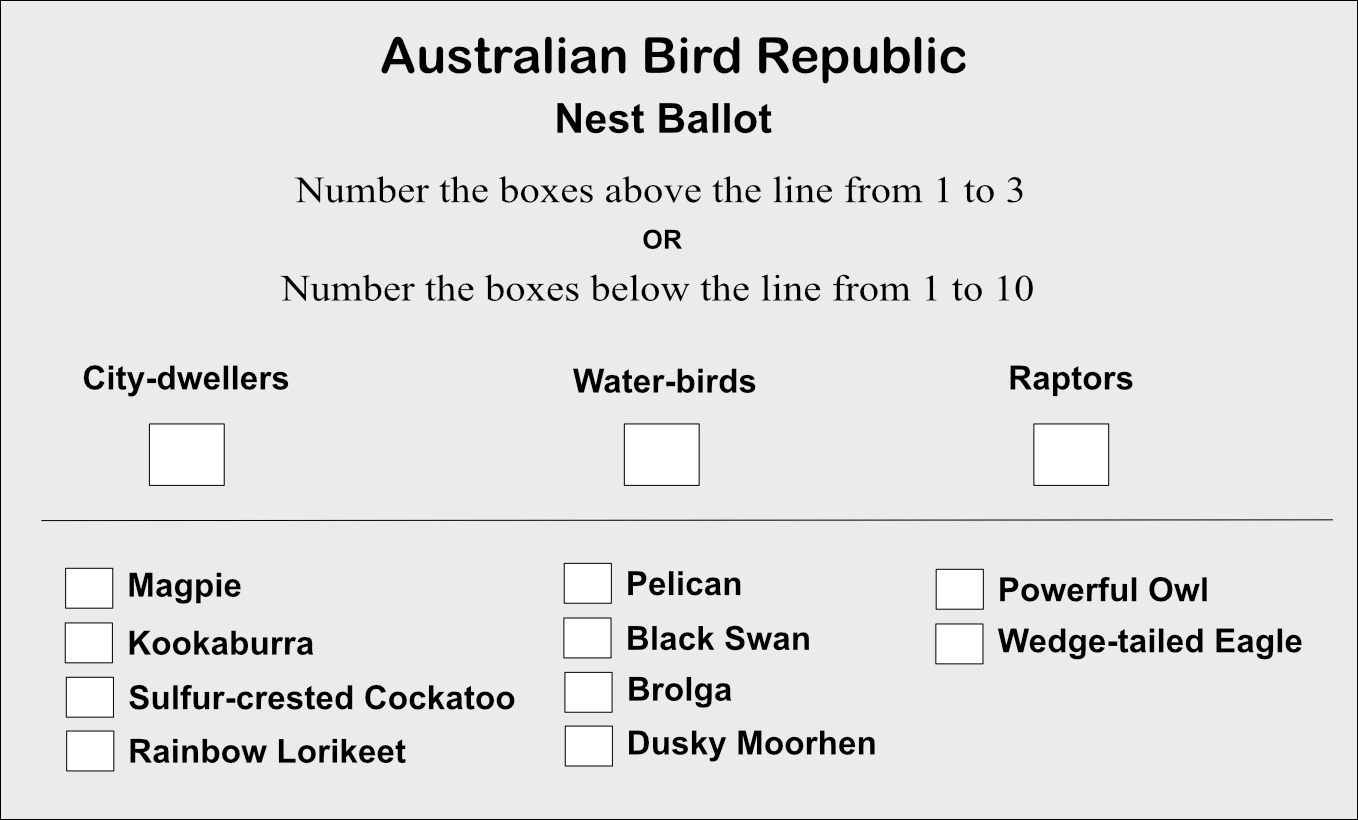
This arrangement of boxes above a line, next to parties, and boxes below a line, next to candidates, is the way Australian Senate ballots are designed.
The Nest ballot mentioned two different ways the ballot could be filled out. The first was to number the boxes above the line and the second was to number the boxes below the line.
Voting above the line
Let's say a voter numbered the boxes above the line as shown below.
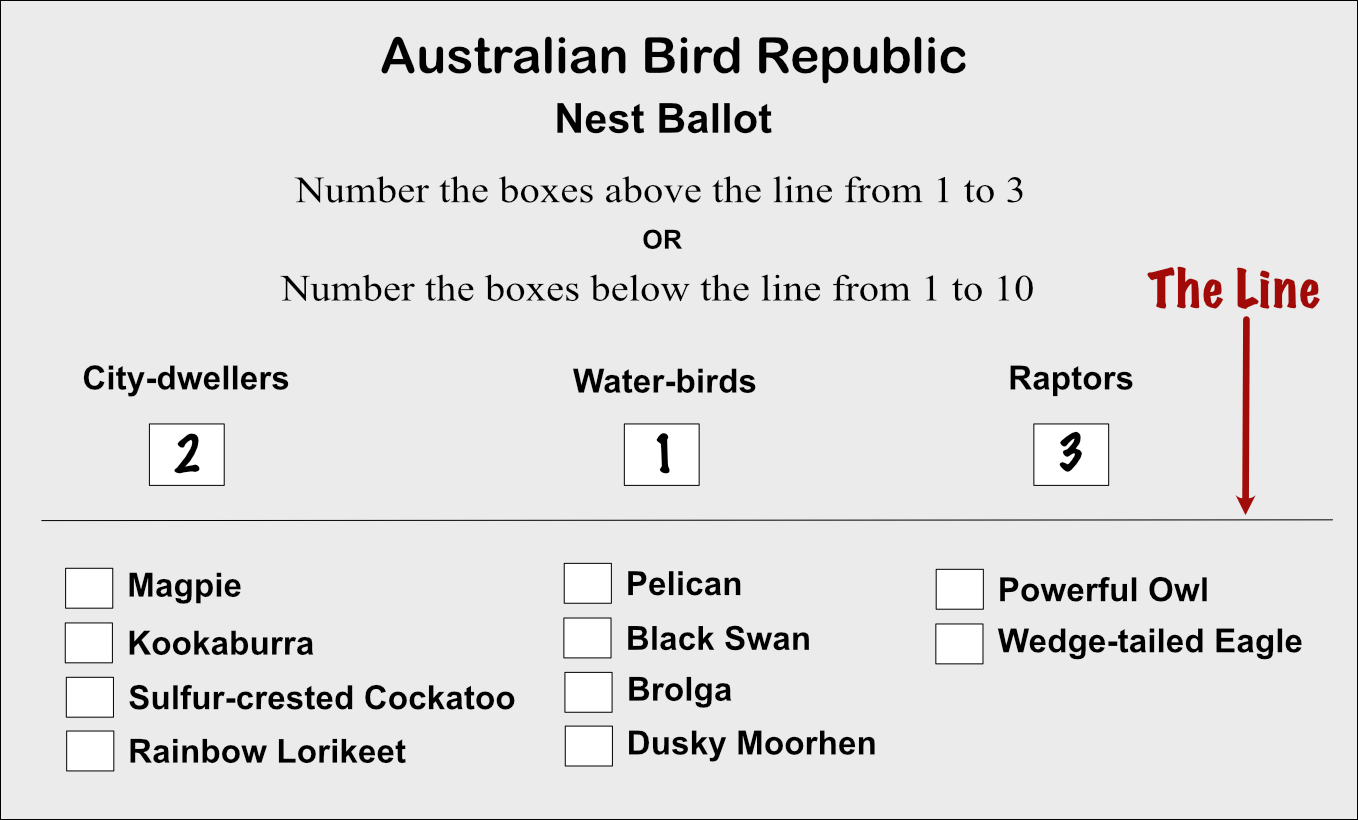
The voter placed a 1 in the box for the Water-birds, a 2 in the box for the City-dwellers, and a 3 in the box for the Raptors.
This means that the voter prefers all candidates in the Water-birds party the most, then the City-dweller candidates, and then the Raptor candidates.
Within each party, the voter is happy to accept the established ordering of the candidates.
This means that the above ballot expresses the following preference ordering over the candidates.
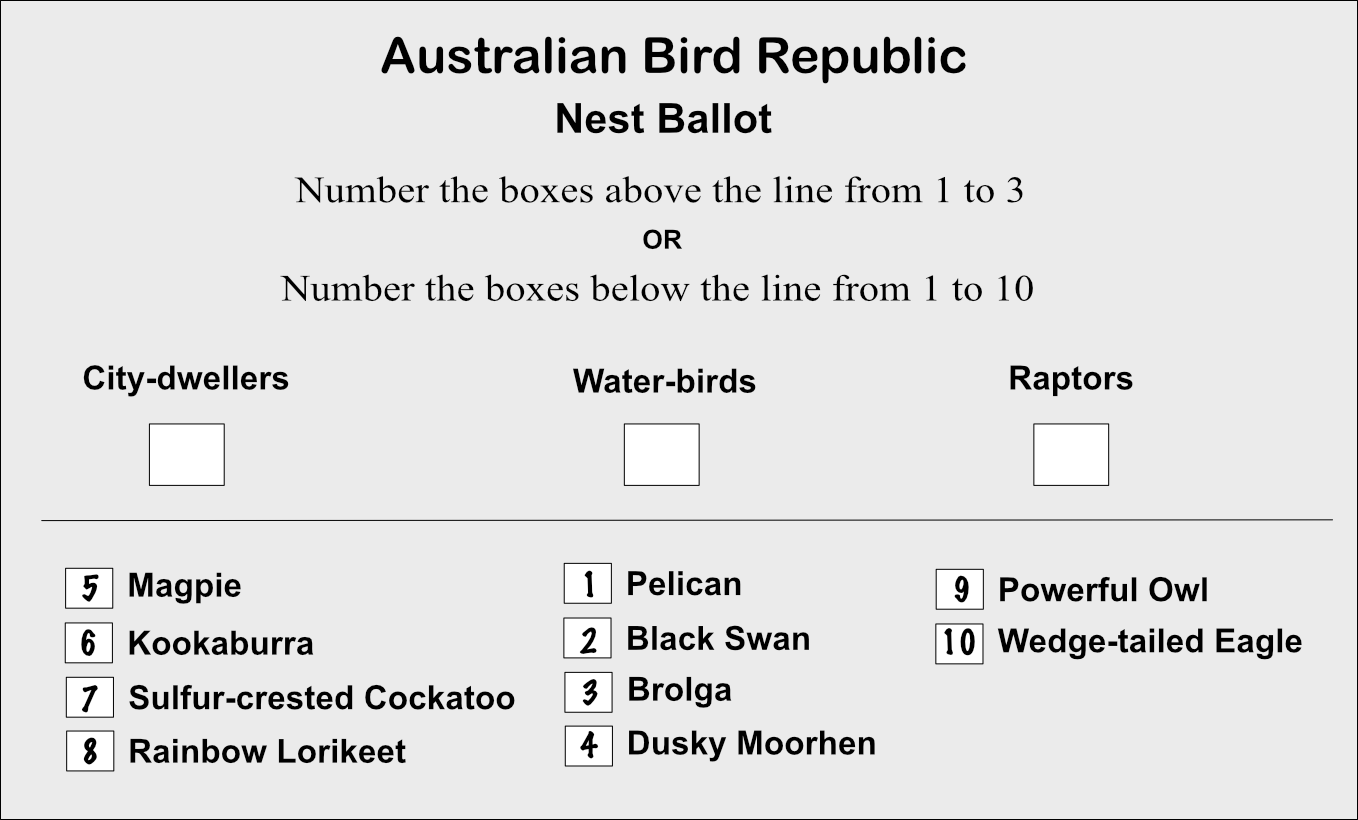
The Pelican is ranked first, the Black Swan second, the Brolga third and the Dusky Moorhen fourth.
The City-dwellers party has been ranked second above the line. This means that we continue to assign the voter's preferences to the City-dweller candidates in the order they are listed. The Magpie is ranked fifth, the Kookaburra sixth, the Sulfur-crested Cockatoo seventh, and the Rainbow Lorikeet eighth.
The Raptors party has been ranked third above the line. So, we continue to assign the voter's preferences to the Powerful Owl (ninth) and the Wedge-tailed Eagle (tenth).
Voting below the line
Sometimes, a voter might like certain candidates in a party better than others. They can express these preferences by voting below the line.
Here is an example of a below the line vote in the Nest election.
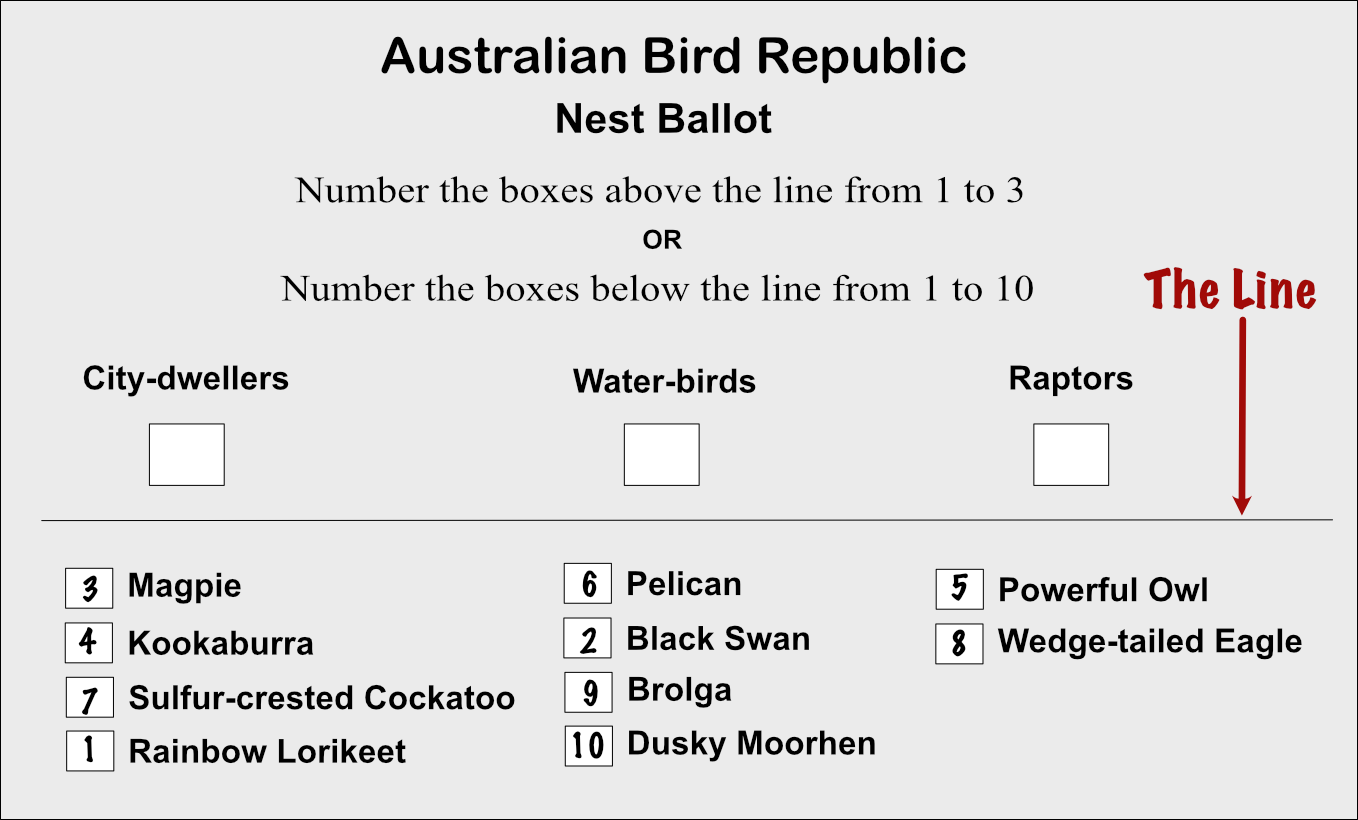
In the above ballot, the voter prefers the Rainbow Lorikeet from the City-dwellers the most out of all the candidates, and then the Black Swan from the Water-birds. The only way the voter can express these preferences is by numbering all the candidates below the line.
The voter has the following preference ordering over candidates, from most to least preferred: Rainbow Lorikeet; Black Swan; Magpie; Kookaburra; Powerful Owl; Pelican; Sulfur-crested Cockatoo; Wedge-tailed Eagle; Brolga; and then the Dusky Moorhen.
Whichever way the voter fills out the ballot, above or below the line, the ballot defines a specific ordering over the complete set of ten candidates.
Election Day
On election day, 150 birds fill out their ballots for the Nest. All birds fill out their ballot correctly, and chose to vote above the line, numbering all boxes above the line from 1 to 3.
In the first column of the table below, we list every ranking that appeared on at least one of the ballots cast in this election. In the second column, we record how many ballots were cast with each of these rankings.
| Preference ranking | Number of ballots |
|---|---|
| City-dwellers then Water-birds then Raptors | 50 |
| Water-birds then City-dwellers then Raptors | 32 |
| Water-birds then Raptors then City-dwellers | 15 |
| City-dwellers then Raptors then Water-birds | 10 |
| Raptors then City-dwellers then Water-birds | 23 |
| Raptors then Water-birds then City-dwellers | 20 |
Counting the Votes
Counting the votes in a Single Transferable Vote election involves a number of steps, and is fairly complex.
The first key concept to understand is that of the quota.
The quota for the 5-seat Nest election is 26 votes. See below to find out how this was calculated.
Calculating the Quota
The total number of valid ballots is 150. If we divide that by one plus the number of seats, which is 6 in total, we get 25. There is no fractional part to round down, and so we simply add one to get the quota of 26 votes.

Now that we have the quota, the next step is to establish the initial tallies for each candidate.
When a voter has numbered candidates below the line, we put the ballot in the tally pile of the candidate who has been ranked first, with a number '1' in their box.
But how does this work when voters have ranked parties above the line? Who do these ballots belong to?
Let's look at one of the ballots that was cast in our election.
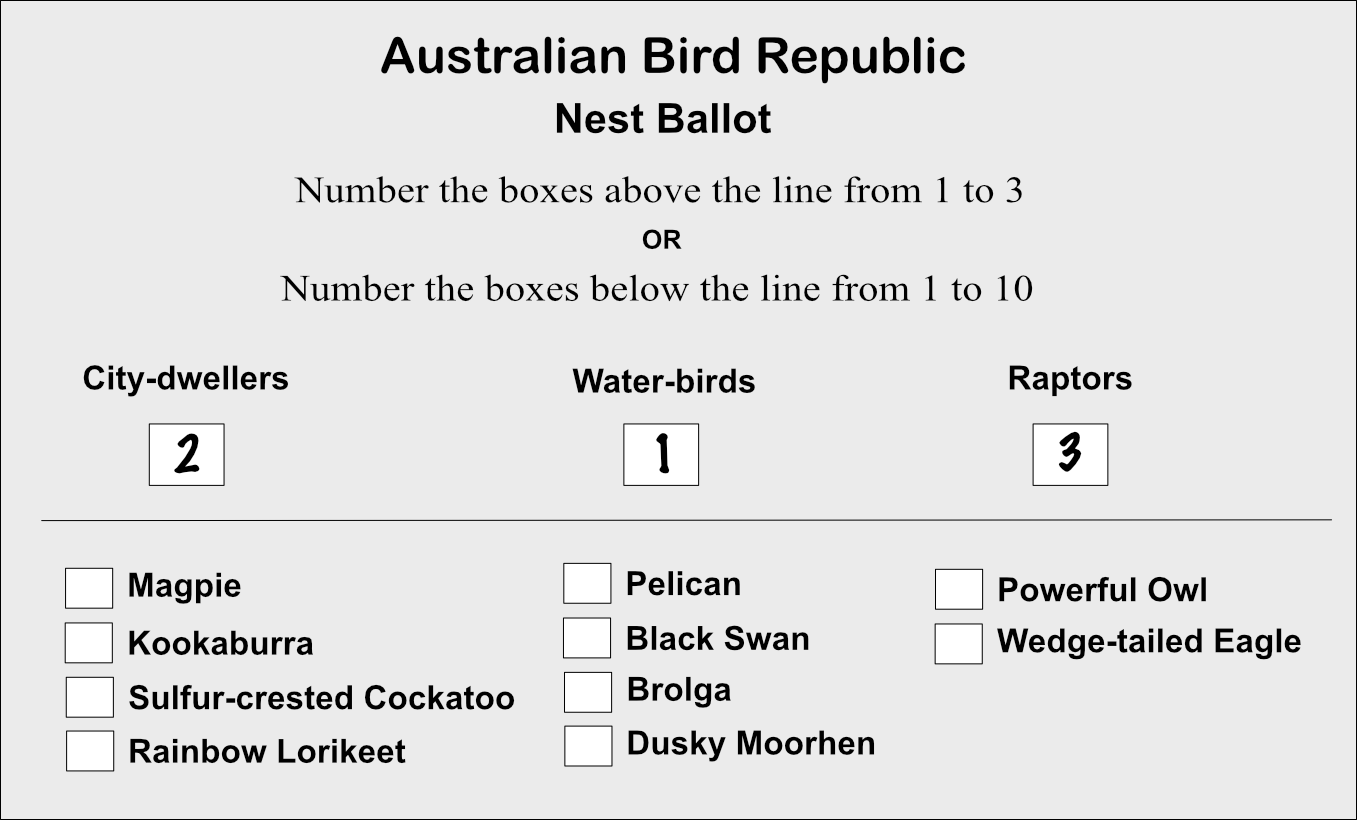
If we remember how an above the line ballot maps to an equivalent below the line ballot, it becomes clear who the number one candidate is.
Interpreting above the line votes
Let's revisit the above the line ballot we saw earlier.
The voter placed a 1 in the box for the Water-birds, a 2 in the box for the City-dwellers, and a 3 in the box for the Raptors.
This ballot is interpreted as if the voter filled it out like this:
The Pelican is ranked first, the Black Swan second, the Brolga third and the Dusky Moorhen fourth.
The City-dwellers party has been ranked second above the line. This means that we continue to assign the voter's preferences to the City-dweller candidates in the order they are listed. The Magpie is ranked fifth, the Kookaburra sixth, the Sulfur-crested Cockatoo seventh, and the Rainbow Lorikeet eighth.
The Raptors party has been ranked third above the line. So, we continue to assign the voter's preferences to the Powerful Owl (ninth) and the Wedge-tailed Eagle (tenth).
At the start of counting, an above the line ballot belongs to the tally pile of the first listed candidate in the party that has been ranked first with a number 1 in its box.
This means the ballot above will initially be placed in the tally pile of the Pelican, as they are the first listed candidate in the most preferred party, the Water-birds.
Let's revisit our table showing how everyone voted.
Reminder: Table of Votes
Recall that the first column in the table below lists all the rankings that appeared on at least one ballot. The second column identifies how many voters cast a ballot with that ranking.
| Preference ranking | Number of ballots |
|---|---|
| City-dwellers then Water-birds then Raptors | 50 |
| Water-birds then City-dwellers then Raptors | 32 |
| Water-birds then Raptors then City-dwellers | 15 |
| City-dwellers then Raptors then Water-birds | 10 |
| Raptors then City-dwellers then Water-birds | 23 |
| Raptors then Water-birds then City-dwellers | 20 |
If we look at our table of votes, we can see that 32 voters ranked the Water-birds party first, the City-dwellers second, and the Raptors third.
As the Water-birds were ranked first, this ballot goes into the tally pile of the Pelican. This is because the Pelican is the first listed candidate in that party.
If we take each ballot, and place it in the pile of the first listed candidate of the party that is ranked first, we get the following initial tallies for each candidate.
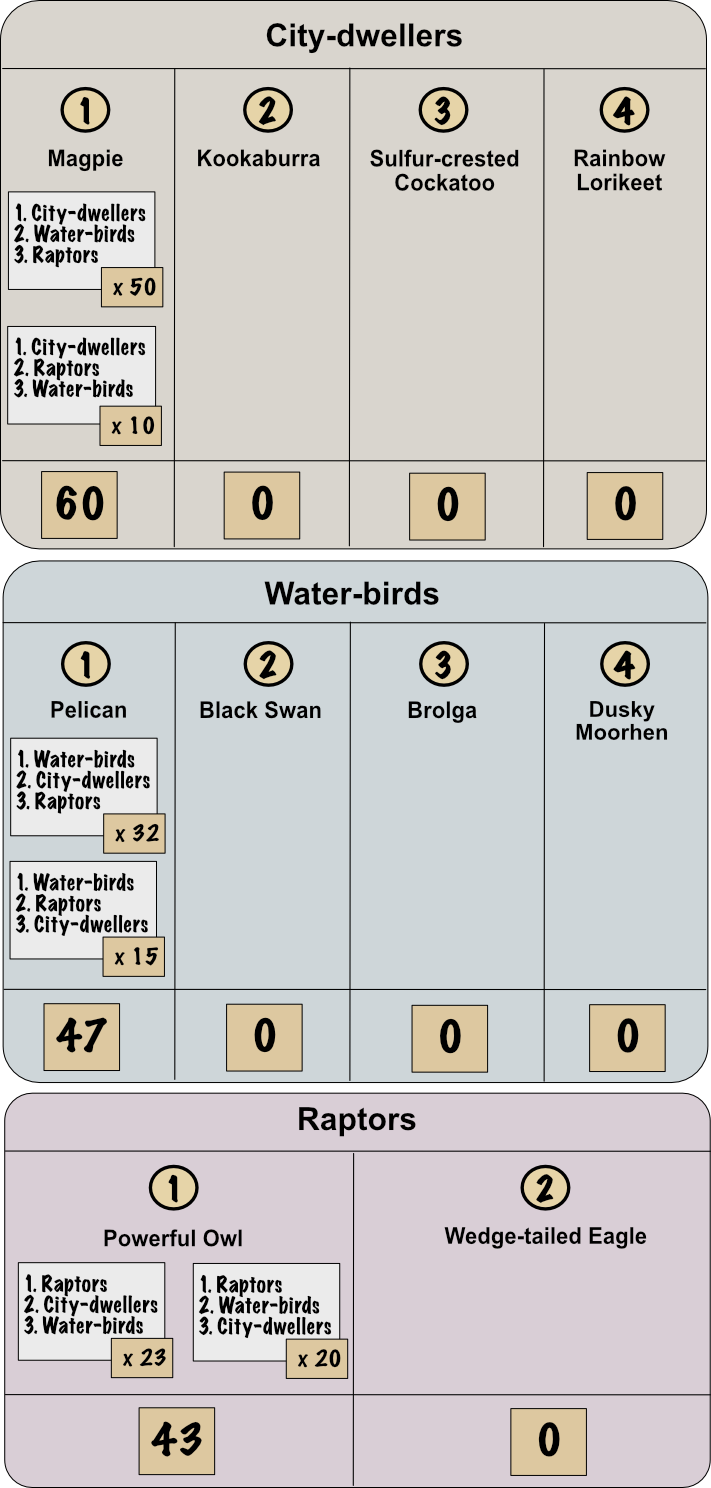
The Pelican, as the first listed Water-bird, is given the 32 ballots that rank the Water-birds first, the City-dwellers second, and the Raptors third, along with the 15 ballots that rank the Water-birds first, the Raptors second, and the City-dwellers third.
The Pelican has 47 votes in their tally, while the Black Swan, Brolga, and Dusky Moorhen have no votes in their tallies.
The Powerful Owl, as the first listed Raptor, is given the 23 ballots that rank the Raptors first, the City-dwellers second, and the Water-birds third, along with the 20 ballots that rank the Raptors first, the Water-birds second, and the City-dwellers third.
The Powerful Owl has 43 votes in their tally, while the Wedge-tailed Eagle has no votes in their tally.
Now that we have initial tallies for our candidates, we can explain the two key steps that we repeat throughout the rest of the counting process.
What do we mean by adjusting the value of a ballot? And how do we work out who the next highest ranked candidate is?
We will answer both questions by looking at the Nest election.
The first candidate in each of the three parties have tallies that are greater than the quota of 26 votes. According to Step Two, we give the first three of the five available seats to the Magpie, the Pelican, and the Powerful Owl.
We will seat these candidates in order of their tally, from highest to smallest.
Step Two: Seating the Magpie, Pelican, and Powerful Owl
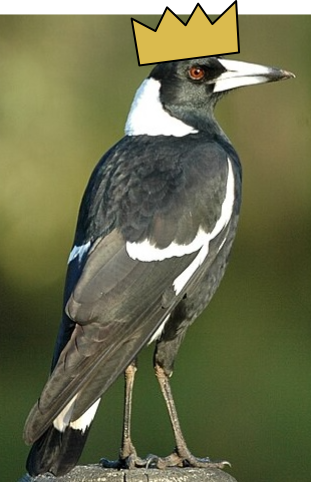
Wikimedia Commons, Aviceda, CC BY-SA 3.0, Modified by adding crown.
The Magpie has 60 votes in their tally, but only 26 of those are needed to get them elected.
What should we do with the other 34 votes? The answer is that we are going to pass them on to their next highest ranked eligible candidate.
Who is the next highest ranked?
In construction
But how do we decide which votes to pass on?
The answer is that we will pass all the ballots on, but will change how much they are worth so that the total value of the Magpie's tally pile becomes 34 votes.
This step is called surplus transfer. The Magpie's surplus is the number of votes they have above the quota. We are transferring the Magpie's surplus, which is 34 votes, to other candidates still in the contest.
The surplus transfer step is defined slightly differently across the different states, territories, and for federal elections. We will focus on what happens in Australian Senate elections for the time being.
In an Australian Senate election, when a candidate is seated, we work out the new value of each of the ballots in their tally pile as shown below.

The Nest election is being counted just like an Australian Senate election.
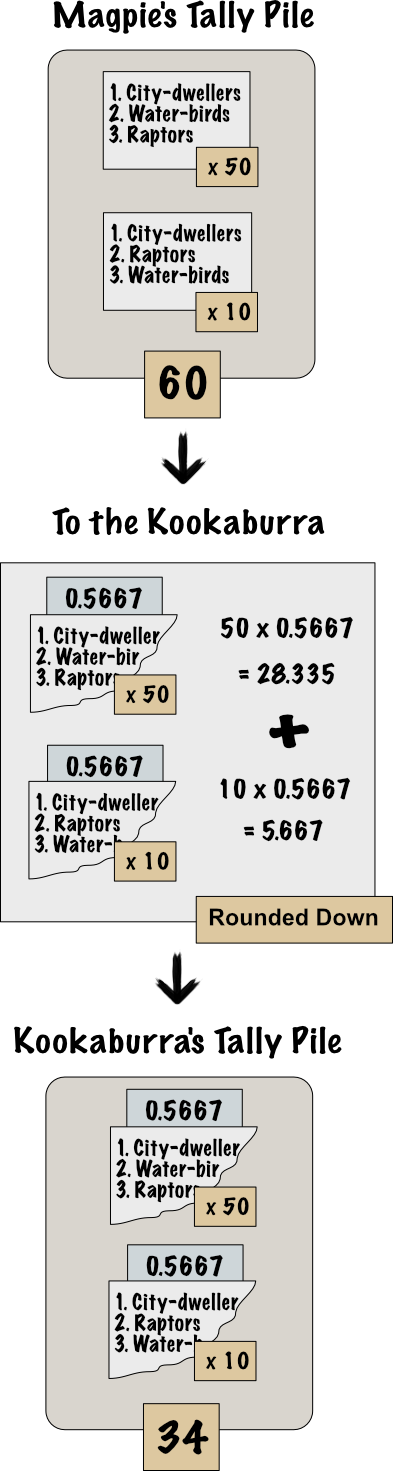
The Magpie has a tally of 60 votes, and 60 ballots in their tally pile. The new value of each of these 60 ballots is reduced to 0.5667.

The Kookaburra is the next highest ranked candidate in all the Magpie's ballots. So, each of the Magpie's reduced-value ballots go to the Kookaburra.
Under Australian Senate counting rules, whenever a bundle of ballots is passed from one candidate to another we round down the total value of those ballots to the nearest whole number when updating the recipients tally. This means that candidate tallies will always be whole numbers
 .
.
The 50 City-dwellers then Water-birds then Raptors ballots have a total value of 50 times 0.5667 equals 28.335.
The 10 City-dwellers then Raptors then Water-birds ballots have a total value of 10 times 0.5667 equals 5.667.
The total value of the bundle of ballots moving to the Kookaburra is rounded down from 34.002 votes to 34 votes.
The Kookaburra's tally is now 0 (previous tally) plus 34 votes, which equals 34 votes.
We treat each ballot in a winner's tally as though only part of it was used to get them elected. The rest of the ballot can then be used to help elect the next most preferred candidate in the voter's ranking.
Now that we have stepped through what happens when a candidate is seated, let's look at what happens when the Pelican and Powerful Owl are seated.
Seating the Pelican
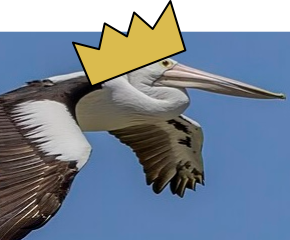
Wikimedia Commons, Charles J. Sharp, CC BY-SA 4.0, modified by adding crown.
The Pelican has 47 votes in their tally, but again, only 26 of those are needed to get them elected. The Pelican has a surplus of 21 votes.
We adjust the values of the ballots in the Pelican's tally pile so that their total value becomes 21 votes.

Each of the ballots in the Pelican's tally pile now has a value of 0.4468.
There are two types of ballots in the Pelican's tally pile, but the Black Swan is the next most preferred candidate on all of them.
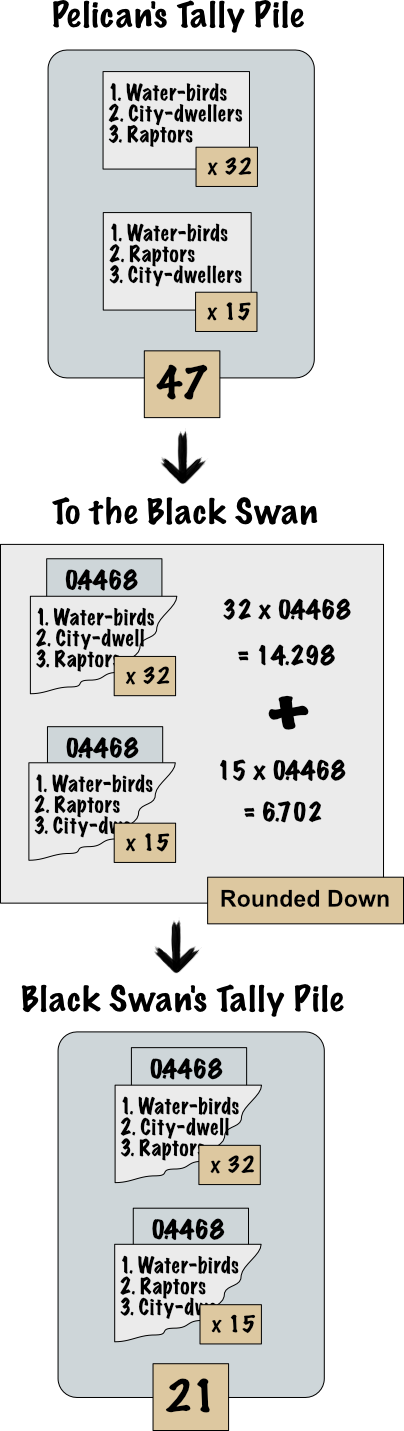
The Black Swan had no votes in their tally pile. Once the Pelican is seated, the Black Swan receives:
- 32 ballots ranking the Water-birds first, the City-dwellers second, and the Raptors third, valued at 14.298 votes in total (32 × 0.4468 = 14.298).
- 15 ballots ranking the Water-birds first, the Raptors second, and the City-dwellers third, valued at 6.702 votes in total (15 × 0.4468 = 6.702).
When we add all these votes together, and round down any fractional bit, we get a total of 21 votes. As the Black Swan's tally was 0 votes before, their tally is now 21 votes.
Seating the Powerful Owl
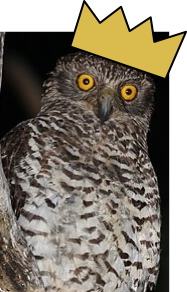
Wikimedia Commons, Greg Tasney, CC BY-SA 4.0, modified by adding crown.
The Powerful Owl has 43 votes in their tally, so their surplus is 17 votes.
We adjust the values of the ballots in the Powerful Owl's tally pile so that their total value becomes 17 votes.

Each of the ballots in the Powerful Owl's tally pile now has a value of 0.3953.
There are two types of ballots in the Powerful Owls's tally pile, but the Wedge-Tailed Eagle is the next most preferred candidate on all of them.
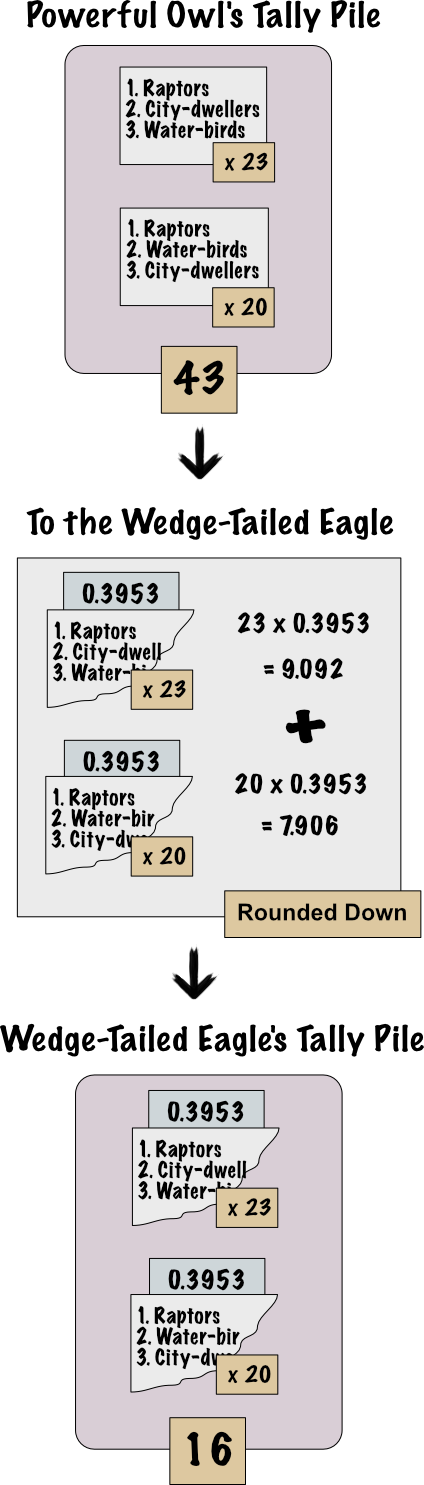
The Wedge-Tailed Eagle had no votes in their tally pile. Once the Powerful Owl is seated, the Wedge-Tailed Eagle receives:
- 23 ballots ranking the Raptors first, the City-dwellers second, and the Water-birds third, valued at 9.092 votes in total (23 × 0.3953 = 9.092).
- 15 ballots ranking the Water-birds first, the Raptors second, and the City-dwellers third, valued at 7.906 votes in total (20 × 0.3953 = 7.906).
When we add all these votes together we get 16.998 votes. We round down the fractional bit, and the Wedge-Tailed Eagle now has a tally of 16 votes.
Let's take a look at all the candidates' tallies after we have seated the Magpie, Pelican, and Powerful Owl.
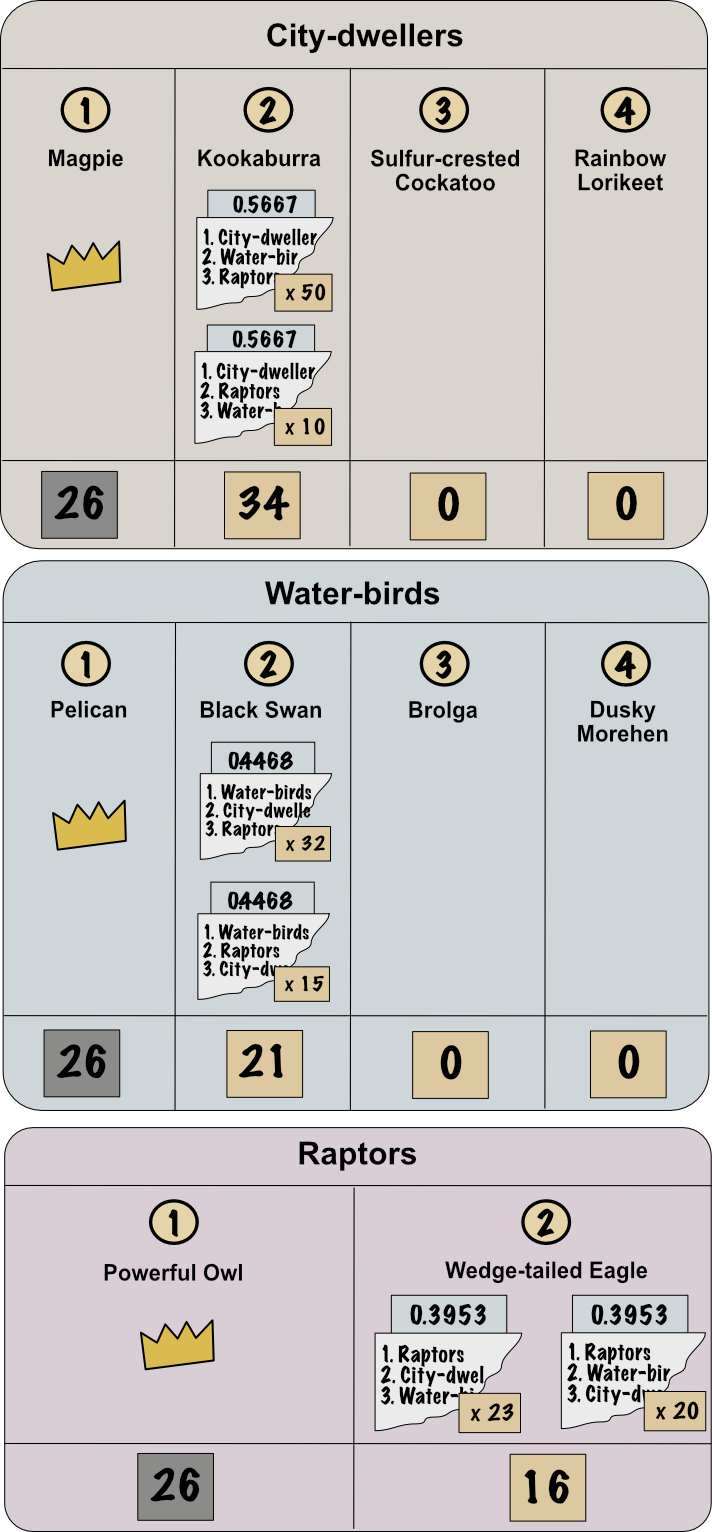
There are now 47 ballots in the Black Swan's tally pile with a total value of 21 votes. The Black Swan now owns the 32 ballots ranking the Water-birds first, the City-dwellers second, and the Raptors third, as well as the 15 ballots ranking the Water-birds first, the Raptors second, and the City-dwellers third.
There are now 43 ballots in the Wedge-Tailed Eagle's tally pile with a total value of 16 votes. The Wedge-Tailed Eagle now owns the 23 ballots ranking the Raptors first, the City-dwellers second and the Water-birds third, as well as the 10 ballots ranking the Raptors first, the Water-birds second and the City-dwellers third.
There are now two seats left to fill. When seating the Magpie, enough votes were transferred to the Kookaburra to give them more than 26 votes.
We now repeat Step Two until we either fill up the 5 seats, or there is no candidate with a quota in their tally pile.
Even though the Kookaburra got their quota when the Magpie was seated, they had to wait until after the Pelican and Powerful Owl got their seats. That's because the Pelican and Powerful Owl had their quota before the Kookaburra got theirs.
Step Two: Seating the Kookaburra
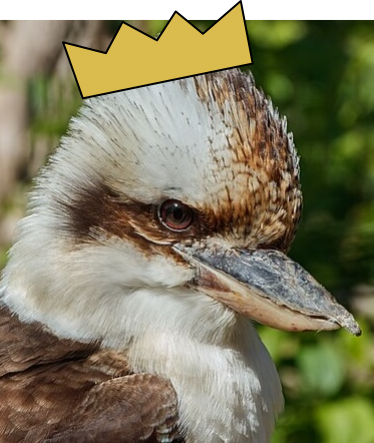
Wikimedia Commons, H. Zell, CC BY-SA 3.0, modified by adding a crown.
The Kookaburra has 34 votes and 60 ballots in their tally pile. Their surplus is 8 votes. We seat the Kookaburra and work out the new value for each of the ballots in their pile.

The new value of each of the Kookaburra's ballots is equal to their surplus, which is 8 votes, divided by the number of ballots in their pile, which is 60.
We will see later examples of other elections where they work out the new value of ballots differently.
All the ballots in the Kookaburra's tally pile have the Sulfur-crested Cockatoo as the next most preferred candidate.
You will have noticed that when a candidate is seated, all their ballots are moving on to the next listed candidate in their party. This is because everyone voted above the line in this election.
All the Kookaburra's ballots move on to the Sulfur-crested Cockatoo at a value of 0.1333 votes each.
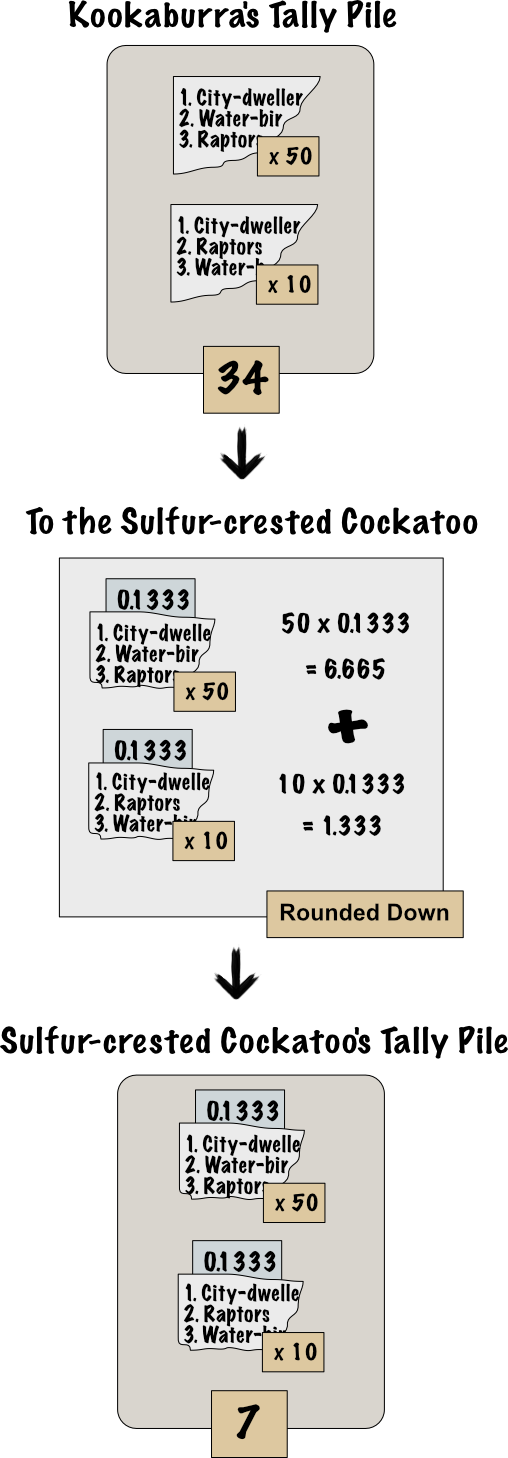
The Sulfur-crested Cockatoo had no votes in their tally pile. Once the Kookaburra is seated, the Sulfur-crested Cockatoo receives:
- 50 ballots ranking the City-dwellers first, the Water-birds second, and the Raptors third, valued at 6.665 votes in total (50 × 0.1333 = 6.665).
- 10 ballots ranking the City-dwellers first, the Raptors second, and the Water-birds third, valued at 1.333 votes in total (10 × 0.1333 = 1.333).
When we add all these votes together we get 7.998 votes. We round down the fractional bit, and the Sulfur-crested Cockatoo now has a tally of 7 votes.
Let's see what the tallies of all of our candidates look like now.
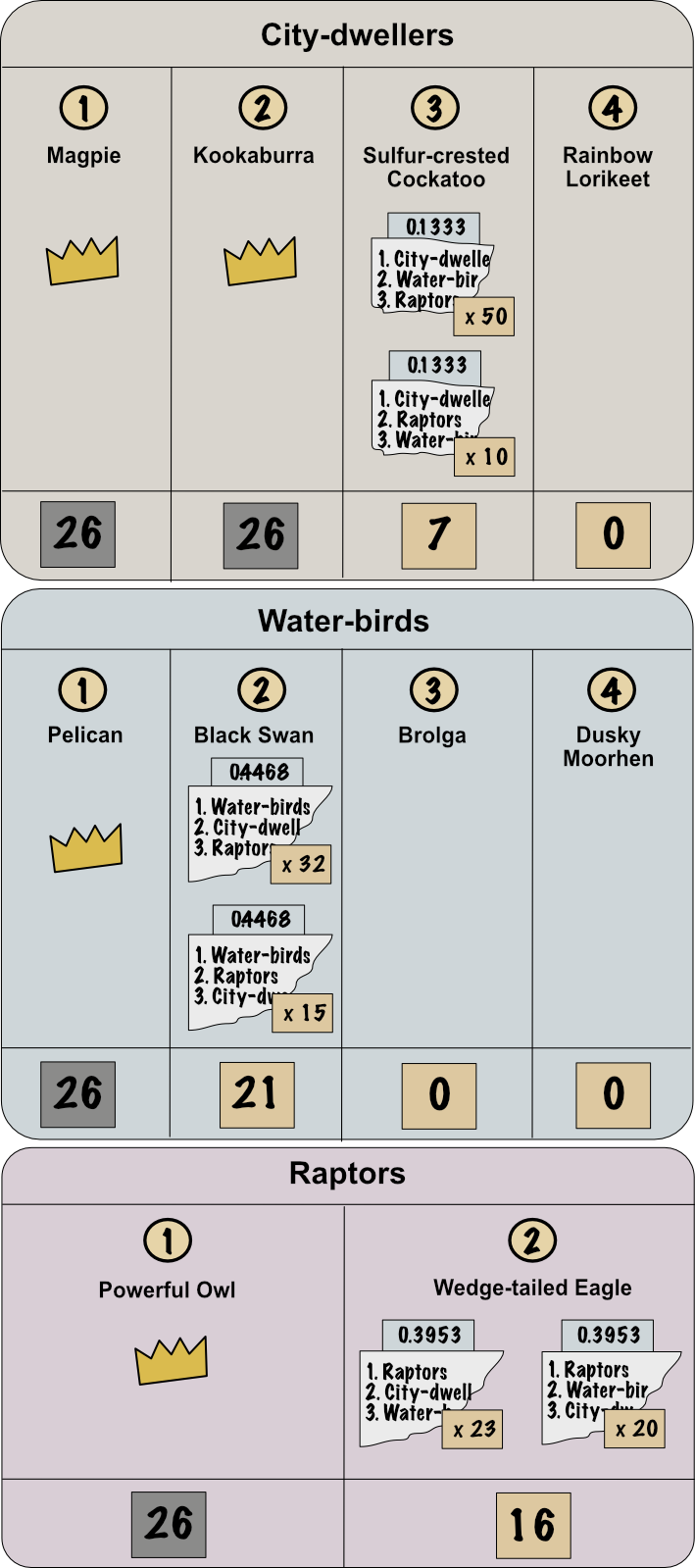
There are still 47 ballots in the Black Swan's tally pile with a total value of 21 votes. The Black Swan now owns the 32 ballots ranking the Water-birds first, the City-dwellers second, and the Raptors third, as well as the 15 ballots ranking the Water-birds first, the Raptors second, and the City-dwellers third.
There are still 43 ballots in the Wedge-Tailed Eagle's tally pile with a total value of 16 votes. The Wedge-Tailed Eagle now owns the 23 ballots ranking the Raptors first, the City-dwellers second and the Water-birds third, as well as the 10 ballots ranking the Raptors first, the Water-birds second and the City-dwellers third.
The Mapgie, Pelican, Powerful Owl and the Kookaburra have been seated. The Rainbow Lorikeet, Brolga, and Dusky Moorhen all have 0 votes with no ballots in their tally piles.
We now have one seat left to fill, but no candidates with a quota in their tally, apart from the ones that we have already seated!
We can now move on to Step Three of the counting process.
Remember that only candidates who are still in the contest, and that don't already have a quota are eligible to receive votes.
There are three candidates with the smallest tally of 0 votes. How do we know which candidate should be removed?
Step Three: Removing the Rainbow Lorikeet, Brolga, and Dusky Moorhen
We repeat Step Three three times, removing the Rainbow Lorikeet, Brolga, and Dusky Moorhen. As these candidates have no votes, removing them doesn't change anyone else's tally.
So, whichever tie breaking rule is used, we get to the following situation.
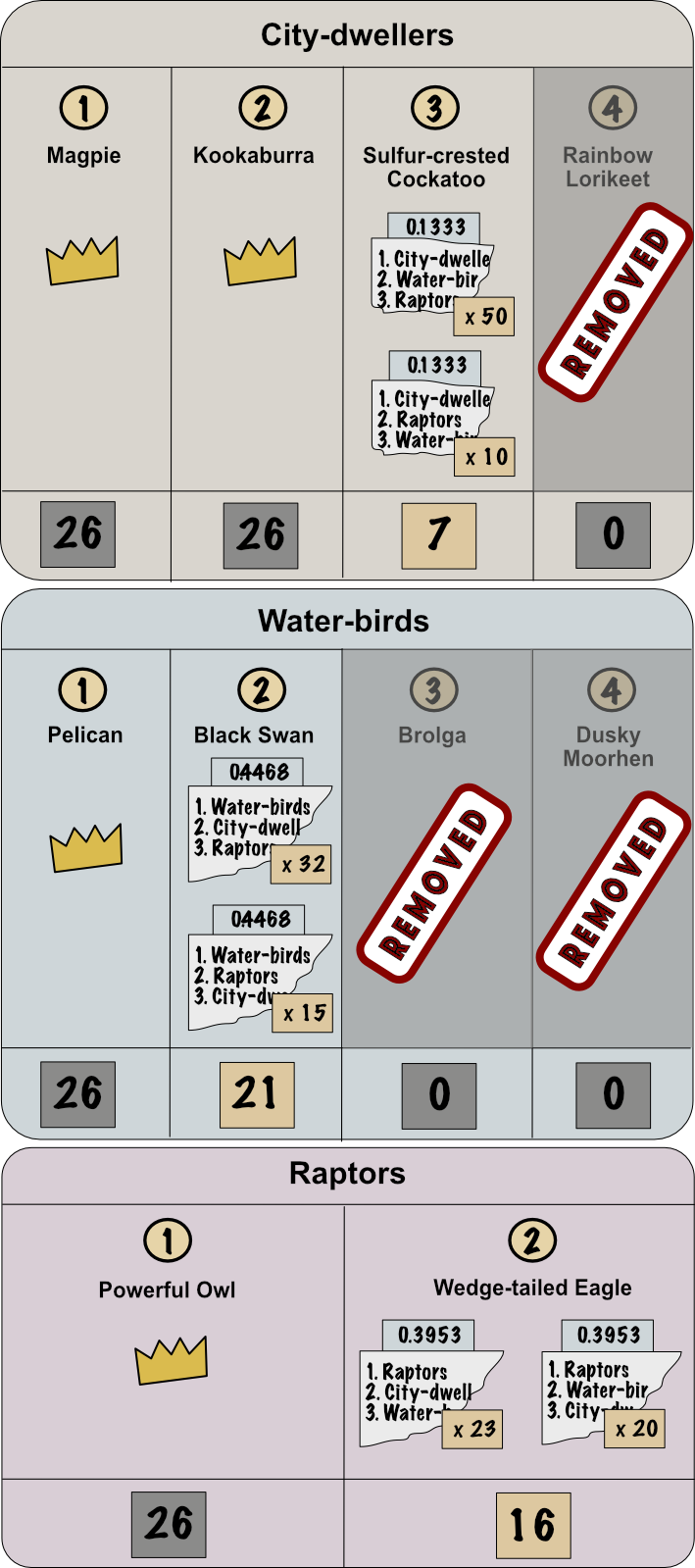
The Sulfur-crested Cockatoo, Black Swan and the Wedge-tailed Eagle are now the only candidates remaining, and we have one seat to fill. The tally piles of these candidates have not changed.
The Sulfur-crested Cockatoo still has 60 ballots in their tally pile with a total value of 7 votes, the Black Swan has 47 ballots in their pile with a total value of 21 votes, and the Wedge-Tailed Eagle has 43 ballots in their pile with a total value of 16 votes.
As none of these remaining candidates has a quota, we can't perform Step Two. So, we need to keep repeating Step Three until either only one candidate is left, or one of the candidate's gets a quota.
Step Three: Removing the Sulfur-crested Cockatoo
The Sulfur-crested Cockatoo has the smallest tally at 7 votes, and so they will be removed from the contest.
Let's have a look at the ballots in the Sulfur-crested Cockatoo's tally pile.
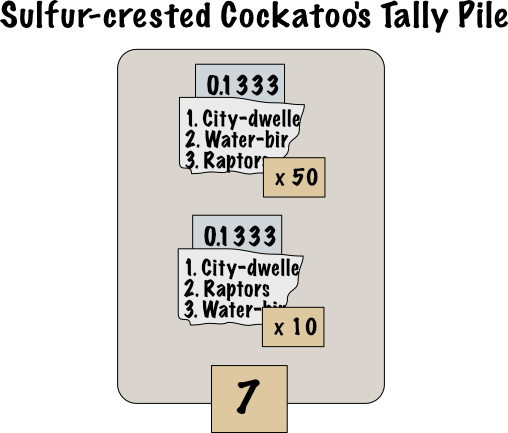
The next most preferred candidate on all the Sulfur-crested Cockatoo's ballots is the Rainbow Lorikeet. But the Rainbow Lorikeet is no longer in the contest! We need to work our way down the preference list until we find a candidate that is still in the contest, and has not already been seated.
For the 50 ballots ranking the Water-birds party second, the next most preferred candidate who is still around is the Black Swan. So, these ballots go to the Black Swan, retaining their value of 0.1333 each.
For the 10 ballots ranking the Raptors party second, the next most preferred candidate who is still around is the Wedge-Tailed Eagle. So, these ballots go to the Wedge-Tailed Eagle retaining their value of 0.1333 each.
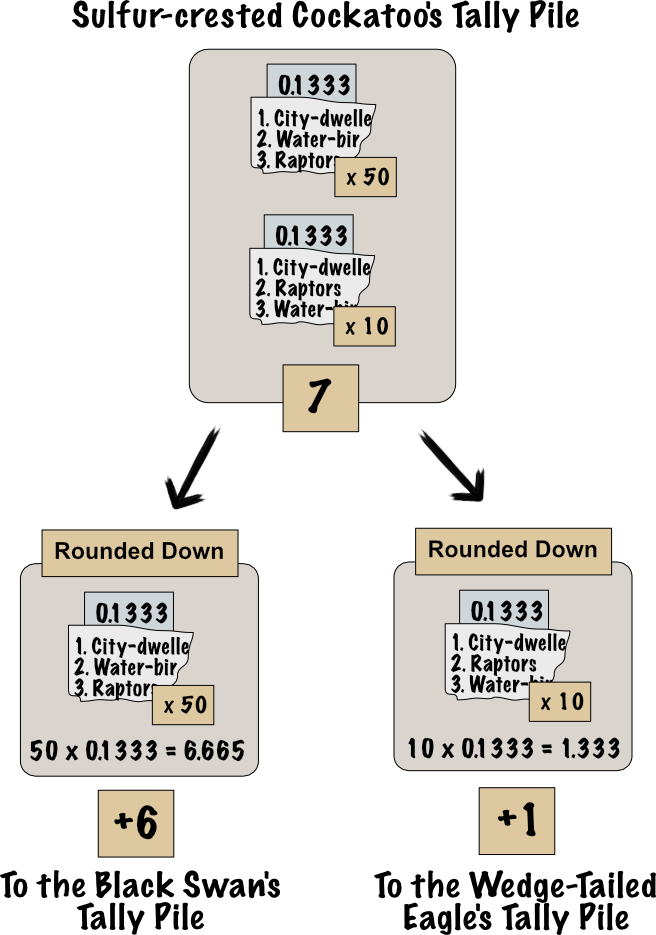
Now let's look at the tally piles of the two remaining candidates, the Black Swan and the Wedge-Tailed Eagle, after the Sulfur-crested Cockatoo was removed.
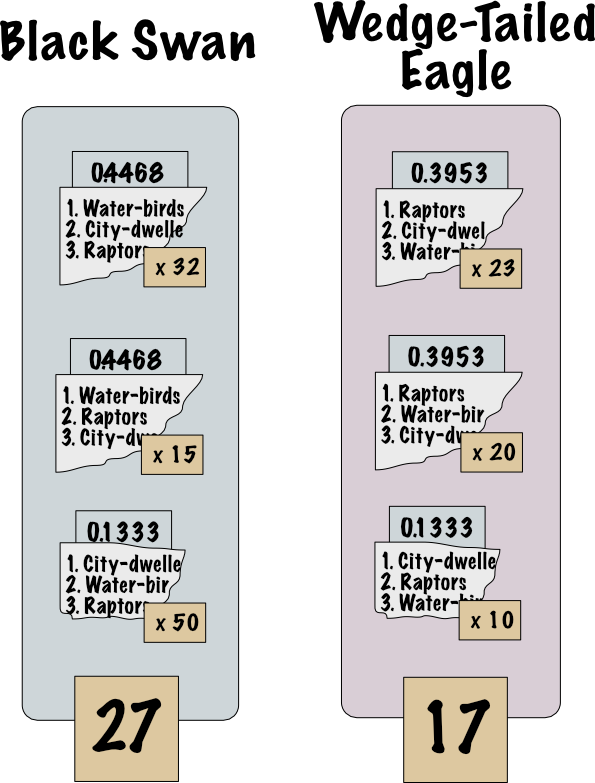
We now have a candidate that has reached the quota!
Step Two: Seating the Black Swan
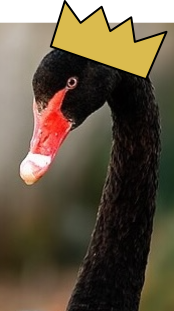
Wikimedia Commons, JJ Harrison, CC BY-SA 3.0, modified by adding crown.
We elect the Black Swan to the last seat. As there are no more seats to fill, the counting process stops.
Summarising the Steps
To find the winners of a Single Transferable Vote election we repeat the steps of electing candidates when they have a quota, and removing candidates when no one has a quota.
We start with Step One: Initial Tallies, below, working out the starting tallies of all our candidates.
Then, if any candidates already have a quota, we repeat Step Two: Seating until there are no remaining candidates with a quota in their tally.
We repeat Step Three: Removing Candidates until either one of the candidates still in the contest gets a quota, or we reach a point where the number of candidates left equals the number of seats we have to fill. In this case, all the remaining candidates get a seat.
We mentioned earlier that there was one situation where a candidate could become a winner without having a quota in their tally.
If the number of seats left to fill equals the number of candidates remaining in the contest, then we elect these candidates whether they have a quota or not.
To do: make above a question and answer.
A Mix of Above and Below the Line
In the example we just worked through, all voters ranked parties above the line.
How would things work when some voters fill out their ballot above the line and some others fill out their ballot below the line?
Example: Mixed vote types
Let's consider a second example in which 140 of the 150 voters fill out their ballot above the line and 10 voters cast a below the line vote.
In construction.
Why do we vote this way?
The introduction of preferential and proportional voting across Australia did not happen all at once, but was the result of a multi-decade journey of electoral reform.
History of preferential and proportional voting in Australia
In the early days of the 20th century, Australia used first-past-the-post to elect candidates to both the House of Representatives and the Senate; the two houses in our federal parliament.
A type of first-past-the-post, known as Block Voting, was used for the Senate.
Prior to federation in 1901, our six states were self-governing British colonies. They held their own elections, which, until the 1850s, generally involved a public ballot.
Australia and the secret ballot
The secret ballot was first introduced in Victoria in 1856, and in South Australia some weeks later.
South Australia's secret ballot is often referred to as the Australian ballot.
Queensland was the first to introduce some kind of preferential voting in 1892—the Contingent Vote. This method was used to elect candidates to their Legislative Assembly until 1942.
The Contingent Vote
The Contingent Vote is a two-round version of the kind of preferential voting used across Australia today.
Each voter ranks the available candidates in order of preference. Each candidate receives all the votes on which they have been ranked first.
If a candidate has more than 50 percent of the total vote, they are declared the winner. Otherwise, all candidates excepting the two with the most votes are removed from the contest. Their votes are given to the next-highest-ranked candidate on the ballot that is still in the contest.
Of the two remaining candidates, the one with the most votes wins.
Tasmania introduced a preferential proportional voting method, known as the Hare-Clark system, for their House of Assembly (lower house) elections in 1896.
The Hare-Clark system is used to elect candidates to their lower house. Preferential voting is used to elect 15 candidates to their upper house, one from each of 15 different geographical regions.
The Hare-Clark system is a type of Single Transferable Vote. This is the technical term for the kind of voting method we use across Australia when we want to elect more than one winner in an election.
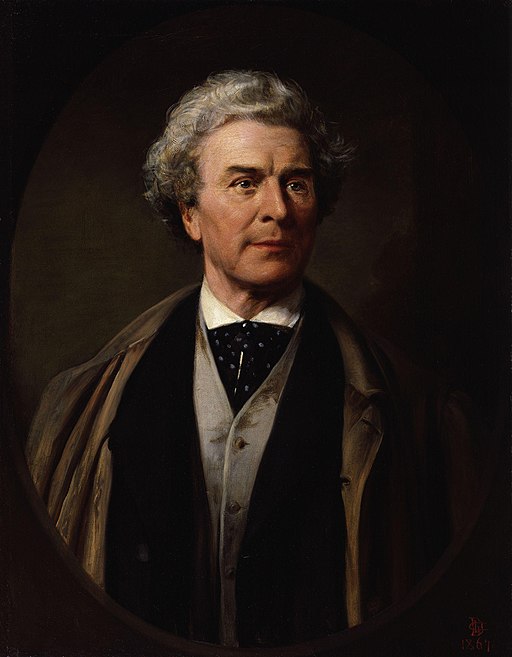
Thomas Hare, Wikimedia Commons, Lowes Cato Dickinson, public domain.
.jpg)
Andrew Inglis Clark, Wikimedia Commons, public domain.
There was an attempt to bring in preferential and preferential proportional voting for Australian federal elections in 1902. This proposed change did not receive enough support, however, so the Commonwealth Electoral Act of 1902 maintained the use of first-past-the-post for federal elections.
It wasn't until 1918 that preferential voting was introduced for the House of Representatives and the Senate. The first federal election to use these systems took place in 1919.
Preferential proportional voting, using the Single Transferable Vote, was not introduced for our Senate until 1948.
Interestingly, different sources make varying claims of who was the first state to introduce preferential voting. Whoever was first, by 1919 some kind of preferential voting was in place across Australia for both federal and state elections.
The Parliamentary Education Office provides a short history of electoral reform in Australia.
While preferential and proportional voting is widespread across Australian elections, it is less common further afield. Explore how citizens vote in elections around the world below.
How people vote around the globe
One of the dominant approaches used around the world is first-past-the-post.
Each voter places a mark next to one candidate on their ballot. In this way, the voter gives their vote to their favourite candidate. The candidate who receives the most votes wins.
To explain how first-past-the-post works, let's revisit our fictional election for Top Bird in the Australian Bird Republic.
First-past-the-post in action
Four candidates are vying for the role of Top Bird in the Australian Bird Republic.
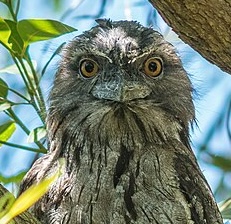 Tawny.
Wikimedia Commons, Cabrils, CC BY-SA 4.0.
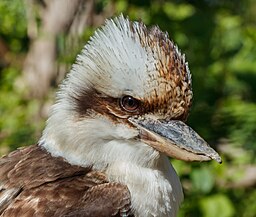 Kookaburra.
Wikimedia Commons, H. Zell, CC BY-SA 3.0.
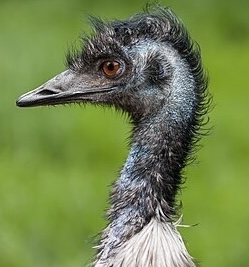 Emu.
Emu.
Wikimedia Commons, William Warby, CC BY 2.0
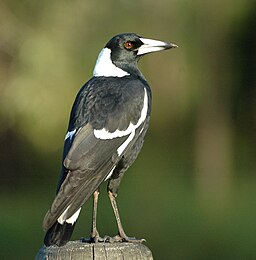 Magpie.
Wikimedia Commons, Aviceda, CC BY-SA 3.0.
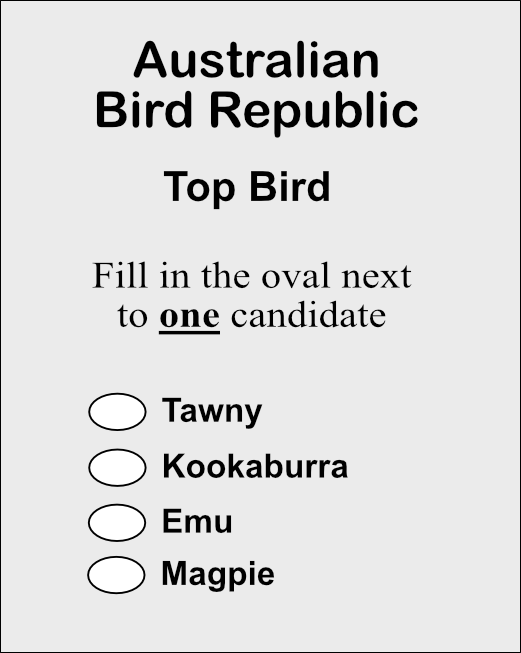
A total of 150 birds are eligible to vote in the Republic. Each bird is given a ballot paper, below, and must fill in the circle next to their preferred Top Bird candidate.
A blank ballot paper
The filled in ballot, below, contains a vote for the Tawny.
A vote for the Tawny
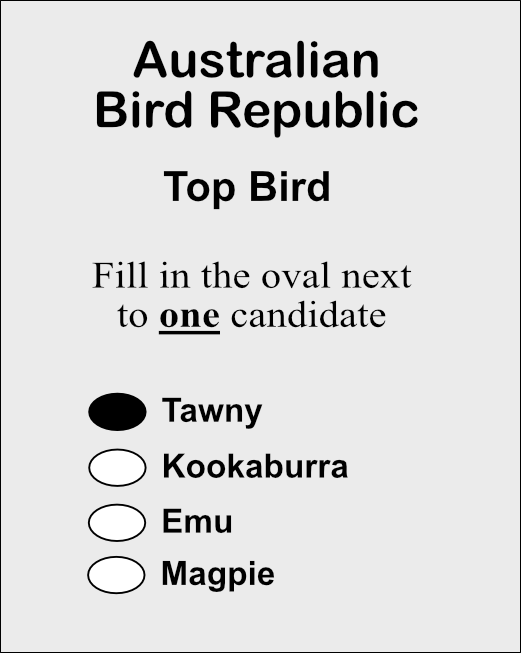
Each bird is only allowed to vote for one candidate, and so can only fill in one of the circles on the ballot paper. If they don't fill in a circle, or fill in more than one circle, their ballot will not be counted.
After the polls have closed, officials count how many votes each candidate received. All 150 voters cast a valid vote.
In this election, the Tawny received 50 votes, the Kookaburra received 40 votes, the Emu received 20 votes, and the Magpie received 40 votes.
As the Tawny received more votes than any of the other of the other candidates, they are elected Top Bird.
First-past-the-post also has a more technical name, Plurality!
Where is first-past-the-post used?
First-past-the-post is widely used across the United States of America for most of their elections.
It is used for some elections in the United Kingdom, including the House of Commons, and local councils in England and Wales. The House of Commons is the lower house of the federal parliament in the United Kingdom. Their upper house is called the House of Lords.
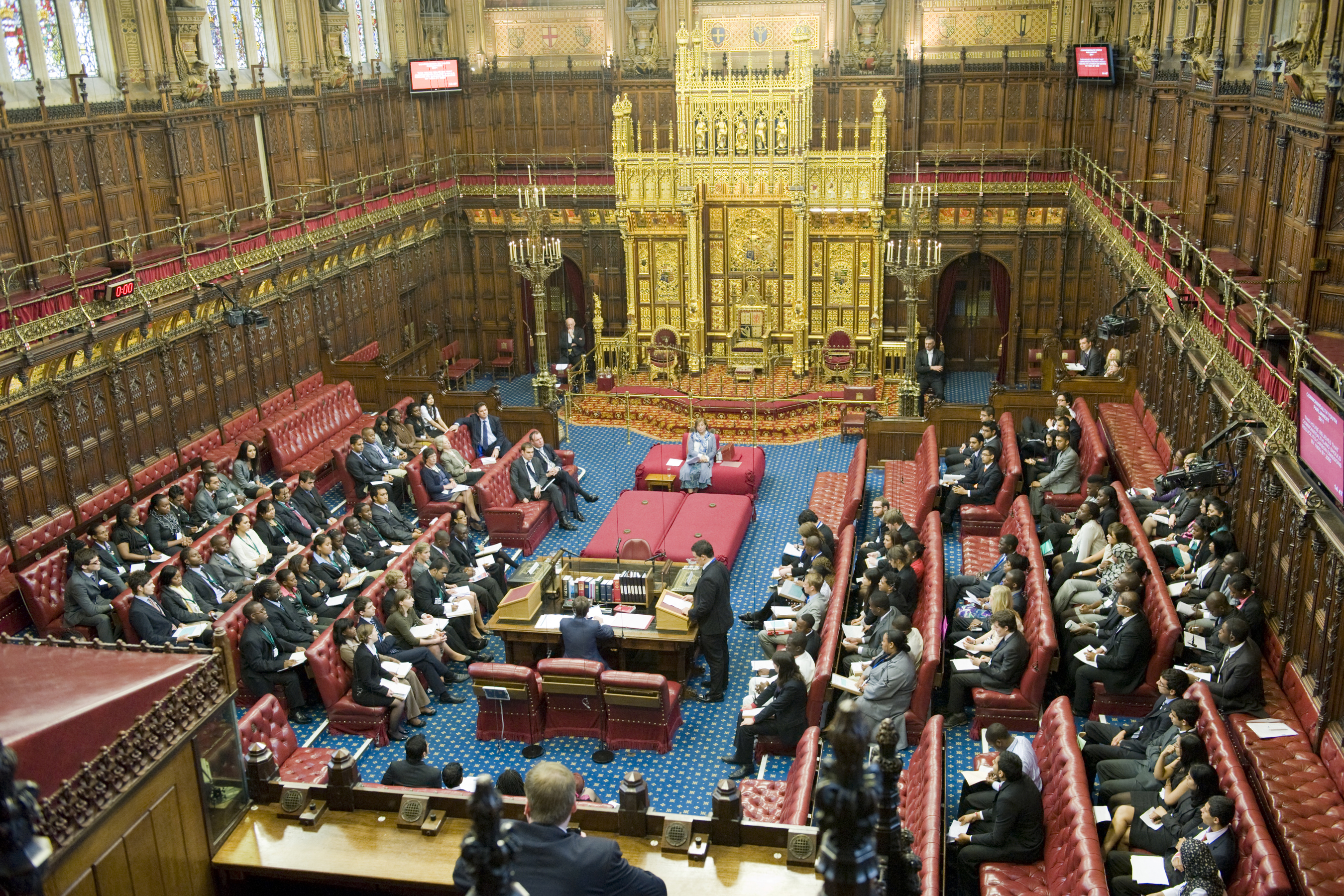
The House of Lords, 2011, Palace of Westminster, London, United Kingdom, Wikimedia Commons, UK government, OGL 3.0, contains public sector information licensed under the Open Government Licence v3.0.
Canada, like Australia, is a Commonwealth nation. Their head of state, like Australia's, is the reigning monarch of the United Kingdom. Their bicameral federal parliament is composed of a lower house, the House of Commons, and an upper house, the Senate. Members of parliament are elected to the House of Commons using first-past-the-post.
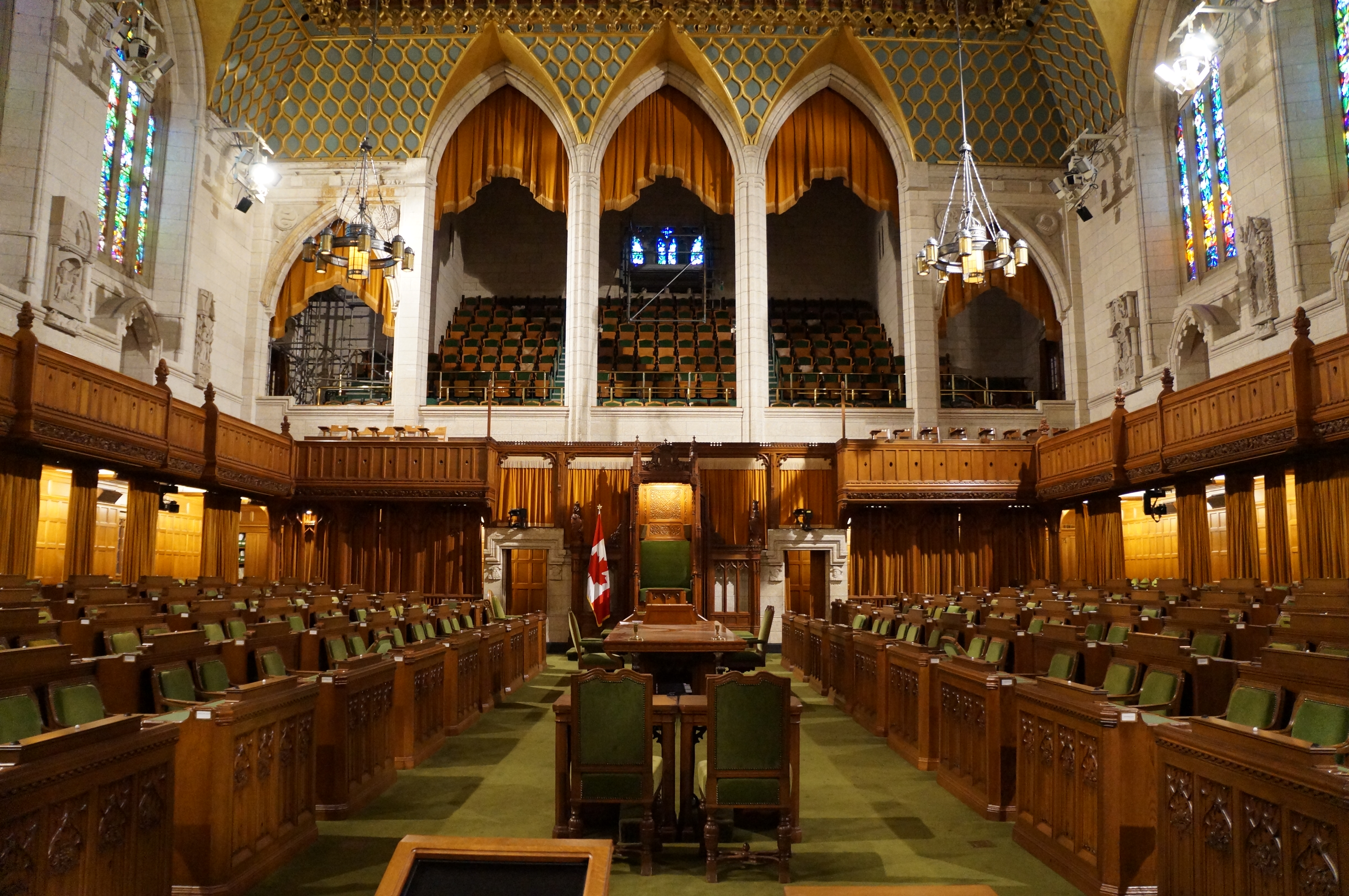
The House of Commons, 2012, Canadian federal parliament, Wikimedia Commons, Jiaqian AirplaneFan, CC BY 3.0.
There are many other countries around the world that use first-past-the-post. Have a look at this Wikipedia article for a list.
In general, Australia uses the Single Transferable Vote—a preferential and proportional election system—when multiple candidates are to be elected by voters.
There are a range of proportional election systems that are more broadly described as party-list systems.
Party-list proportional systems
This type of election is common across Europe.
Ballots generally present a series of lists, one for each party, where each list contains the candidates of that party.
The image below shows a ballot for a council election in Hesse, Germany, that uses a party-list proportional election system.
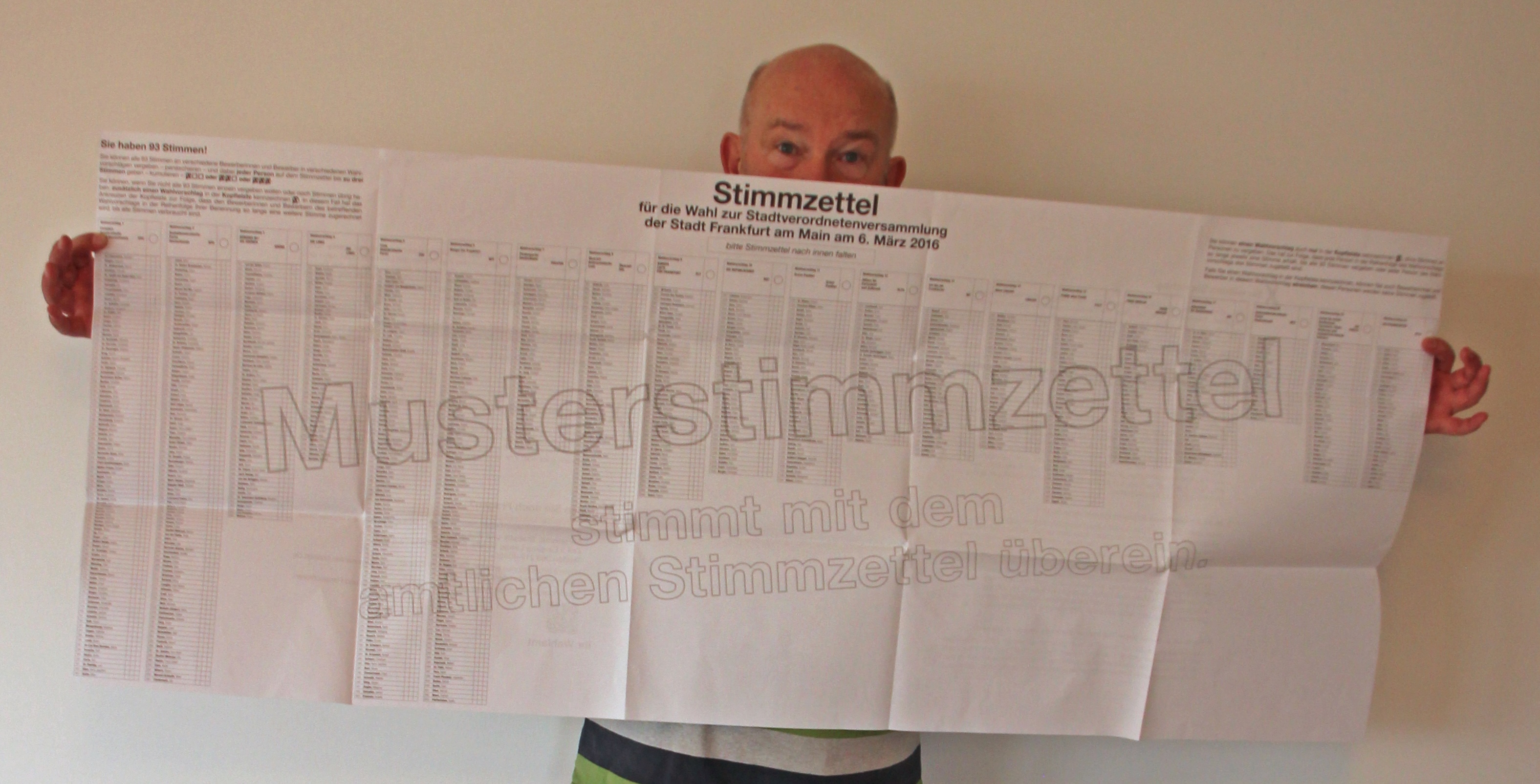
Wikimedia commons, Frank C. Müller, CC BY-SA 4.0.
How voters cast their ballot in a party-list election varies depending on location and the specific party-list flavour being used.
Typically, voters will vote for a single party, and the number of votes each party receives will determine how many seats they will win. Candidates are then given a seat based on their position in the list they belong to.
The following Wikipedia article identifies several categories of party-list proportional election systems.
Explore the following resources for more information on the variety of election systems in used across the globe.
Resources
For more detail on the different election systems in use around the world, have a look at the following resources.Resources
Resources on how we vote, and how our votes are counted, in Australian elections.
General Explainers
Federal Elections
Victoria
Educational material about how voting works in Victorian state elections
Educational material about the types of elections held in Victoria
Educational material about how votes are counted in Victorian elections
New South Wales
Educational material about how voting works in NSW state elections
Educational material about how votes are counted in NSW state elections
South Australia
Educational material about how voting works in South Australian state elections
Educational material about how votes are counted in South Australian state elections
Queensland
Educational material about how voting works in Queensland state elections
Information about elections in Queensland
Educational material about elections in Queensland, including the counting of votes
Western Australia
Educational material about how voting works in WA state elections
Information about the types of elections held in WA
Educational material about elections in WA, including the counting of votes
Tasmania
Information about the types of elections held in Tasmania
Educational material about how votes are counted in Tasmanian state elections
Australian Capital Territory
Information about how voting works in ACT elections
Educational material about how votes are counted in ACT elections
Northern Territory
In this prototype of Explain That Election, a selection of House of Representatives and Senate elections are available to explore. Select the Federal level of government, then the chamber of interest (House or Senate), and an election year. You will then be able to select a seat (House) or state/territory (Senate) to step through the count.
Level of government
Chamber
State or Territory
Chamber
Year
Title
Overall Result
There are seats in the .
The chart below shows which parties won seats in this election and how many.
Federal Electorates
Enter an electorate to explore its House of Representatives election in .
Filter by state or territory
| Electorate | State/Territory |
|---|
States and Territories
Select a state or territory in the table below to explore its Senate election in .
| State/Territory | Seats |
|---|
Electoral Regions
Enter an electoral region to explore its election in .